


Asia’s First Study: 5 Sessions of Proton Therapy to Control Early-Stage Prostate Cancer
HONG KONG, March 20, 2026 /PRNewswire/ — HKSH Medical Group (HKSH) today announced the results of Asia’s first clinical study on early-stage prostate cancer patients receiving five-session of proton therapy.* The results show significant efficacy, with a marked decline in prostate-specific antigen (PSA) levels and only mild side effects. Proton therapy for prostate cancer generally requires about 30 treatment sessions over 8 to 9 weeks. Since the launch of proton therapy service in 2023, HKSH Cancer Centre has advanced the precision of treatment to achieve “hypofractionation”, drastically reducing the number of treatment session by 80%. For early-stage prostate cancer, there is an option of 5 sessions of proton therapy within 2 to 3 weeks to achieve disease control. The unique physical properties of proton beam can precisely target the tumour with minimal damage to nearby vital organs such as the bladder and bowel, thereby helping to enhance patients’ quality of life throughout their cancer journey.



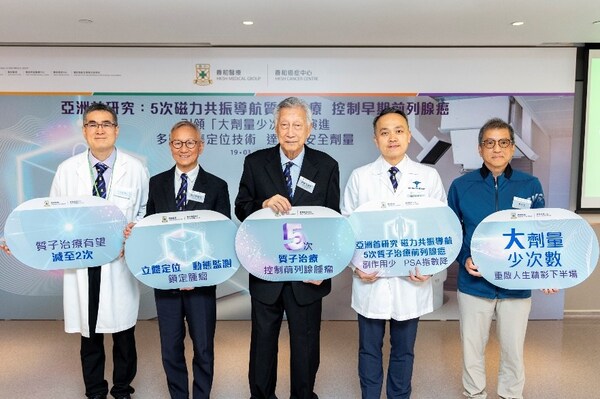
(From left) Dr. Ben YU, Head of Medical Physics Department of HKSH, Dr. Joseph CHAN, Chief Medical Officer, HKSH Medical Group and Deputy Medical Superintendent, Hong Kong Sanatorium & Hospital, Mr. Wyman LI, Chief Operating Officer, HKSH Medical Group and Director, Hong Kong Sanatorium & Hospital, Dr. Darren POON, Associate Director, HKSH Comprehensive Oncology Centre announced the data from Asia’s first MRI-guided five-session proton therapy study for early-stage prostate cancer patients.
Mr. Wyman LI, Chief Operating Officer of HKSH Medical Group and Director of Hong Kong Sanatorium & Hospital, remarked, “The integration of proton therapy and targeting technologies is the cornerstone to the successful implementation of ‘hypofractionation‘. This achievement also reflects HKSH’s ongoing commitment to advancing clinical application, enabling cancer patients to benefit from even more advanced precision treatments with less side effects. Taking a further leap forward, the HKSH research team is now exploring the feasibility of further reducing treatment of early-stage prostate cancer using proton therapy from 5 to 2 sessions. HKSH has also introduced the world’s first Photon-Counting CT Simulation System (PCCT-Sim) with advanced simulation capabilities which can be applied in prostate cancer proton therapy planning for even more effective disease control.”
Asia’s First Study: Five Sessions of Proton Therapy to Target Prostate Tumours
Prostate cancer predominantly affects older adults, but risk does not simply rise with age, the incidence is highest among those aged 65–74. Local data in 2023 shows that new cases in this age group account for about half of all diagnoses, underscoring the urgent need for more effective cancer management strategies. To assess the clinical efficacy of five-session proton therapy, HKSH commenced a clinical study to analyse the data of 94 early-stage prostate cancer patients who received Stereotactic Body Proton Therapy between June 2024 and January 2026. The report covers a median follow-up of 10.93 months (range: 0.9 to 25.5 months). After five sessions of proton therapy, the patients’ PSA levels dropped sharply from a baseline of 12.57 ng/mL (±13.59 ng/mL) to 1.13 ng/mL (±2.07 ng/mL) three months post-treatment, maintaining high efficacy despite fewer treatment sessions.
Dr. Darren POON, Associate Director of HKSH Comprehensive Oncology Centre and Specialist in Clinical Oncology, who led this study explained that due to the high concentration of proton beams and precise delivery to the target area striking the tumour, the majority of patients in the study did not experience adverse reactions of Grade ≥2 toxicities after treatment. Patient-Reported Outcome Measures (PROMs) indicated favorable urinary and bowel function scores three months post-treatment, suggesting minimal impact on quality of life. The most common adverse reactions were related to the urinary system. During the acute phase, 33.0% (31/94) of patients experienced relatively mild Grade 1 dysuria i.e. having difficulty in urination, which subsequently improved. This study is still ongoing to gather long-term follow-up data. As Asia’s first study on magnetic resonance imaging-guided five-session proton therapy, it further establishes HKSH’s leading position in the field of proton therapy within the region and provides an important foundation for developing more precise and safer treatment options across Asia in the future.
Hypofractionation: Precision Planning and Targeting
Dr. POON pointed out that the core technologies behind “hypofractionation”: “For every case and treatment, our proton therapy team would utilise Intensity Modulated Proton Therapy (IMPT) with pencil-beam scanning. Before treatment, the tumour’s shape and size are delineated, and the radiation intensity of each beam at different positions within the tumour is precisely calculated. Patients would also undergo MRI and CT scans before treatment, which are cross-referenced with the proton therapy system’s real-time X-ray imaging to ensure accurate targeting.” To further protect nearby organs, doctors may use rectal spacers to increase rectum-prostate distance. Bladder volume scans are also performed to assess bladder filling before each treatment session, aiding in accurate tumour targeting to minimise unnecessary radiation exposure.
Hypofractionation: Overcoming Tumour Movement, Minimising Side Effects
Proton beam accurately targeting the tumour according to treatment plan can greatly reduce side effects. However, prostate tumours may shift slightly due to soft-tissue movement. Even though these movements are slight, HKSH strives to minimise any deviation to the smallest possible range, further reducing the risk of side effects. Multiple techniques are applied clinically, including implanting fiducial markers within the prostate to track the tumour’s position real-time, ensuring precise radiation delivery to the tumour.
The number of treatment sessions and potential side effects are primary factors for cancer patients when considering radiotherapy. The promising clinical results of HKSH’s five-session proton therapy provide strong reassurance to patients, allowing greater flexibility for personalised treatment plans. Building on this, HKSH has already commenced a clinical study on two-session proton therapy. This study will enroll 35 patients with histologically diagnosed low-to-intermediate risk localised prostate cancer and will follow them for five years. The aim is to investigate both the short-term and long-term safety and efficacy of the treatment. These findings will help doctors and patients make more informed decisions about “hypofractionation”.
HKSH firmly believes that talent and technology are equally important. HKSH collaborated with the National Cancer Centre to organise the ‘Proton Therapy Joint Training Course’ in June 2025 and subsequently commenced the 10-month ‘HKSH Cancer Centre Proton Therapy Training Programme’. In November 2025, HKSH hosted the Annual Conference of the Asia-Oceania Particle Therapy Co-operative Group (PTCOG-AO) as a platform to integrate clinical expertise with a global perspective. HKSH aims to establish a premier platform for continuous learning and advancement in the Asia-Pacific region, elevating the overall standard of proton therapy to benefit more patients.
Patient Sharing – Mr. Li
Mr. Li, a 69-year-old retired teacher, discovered elevated PSA levels (>12 ng/mL) and an enlarged prostate during a routine checkup in December 2024, despite no symptoms. The checkup also revealed coronary artery blockage, requiring an angioplasty procedure and anticoagulant medication in March 2025, delaying prostate cancer treatment. In September 2025, Mr. Li underwent a biopsy at a public hospital and was diagnosed with early-stage prostate cancer with no metastasis. As Mr. Li and his family preferred to avoid surgery, the public hospital considered conventional radiotherapy more suitable for Mr. Li’s overall health condition than the shorter-course stereotactic body photon radiotherapy, and advised him to undergo 20 sessions of treatment.
Although his PSA had risen to over 14 ng/mL by then, Mr. Li and his family were concerned about the relatively long course of conventional radiotherapy and its potential side effects. After learning more about proton therapy with minimal impact on surrounding vital organs and the prospect of controlling the tumour with just five sessions, he decided to proceed with proton therapy and commenced his 2.5-week course of treatment in December 2025. Mr. Li shared that he experienced almost no discomfort during or after the treatment, with just some markings on his hip, describing it as “feel like haven’t undergone any treatment at all”. His PSA level has also dropped significantly. Mr. Li is grateful for the opportunity to receive proton therapy as he can now continue to enjoy jogging and travelling with his wife, spending quality time with his grandchildren.
*Stereotactic Body Proton Therapy (SBPT) for Localized Prostate Cancer: Preliminary Clinical Results of Clinician- and Patient-Reported Outcomes [source – PTCOG-AO 2025]
# Please email to [email protected] for more information about HKSH’s proton therapy clinical study.
About HKSH Medical Group
Officially launched in September 2017, HKSH Medical Group promotes public health and advanced medicine through a multi-faceted, coordinated approach across clinical services, medical education, scientific research and public health education. Members of the Group, including Hong Kong Sanatorium & Hospital, HKSH Healthcare, HKSH Eastern Medical Centre, HKSH Cancer Centre and HKSH Institute for Innovation & Professional Development, are dedicated to offering top-quality holistic care to patients.
Established in 1922, Hong Kong Sanatorium & Hospital is one of the key members of HKSH Medical Group and a leading private hospital in Hong Kong. Living up to its motto of ‘Quality in Service, Excellence in Care’, the Hospital is committed to serving the public as well as promoting medical education and research.
For more information about HKSH Medical Group, please visit http://www.hksh.com.

