


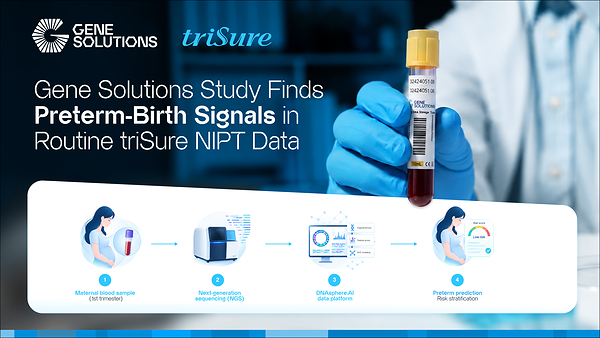
A Gene Solutions study published in American Journal of Obstetrics & Gynecology (AJOG) Global Reports finds cell-free DNA fragmentomic patterns associated with spontaneous preterm birth, pointing to a potential path toward earlier pregnancy-risk assessment.
SINGAPORE, Sept. 25, 2026 /PRNewswire/ — Gene Solutions, a global biotechnology company providing precision cell-free DNA solutions through multi-omics and artificial intelligence to improve pregnancy care, cancer detection and precision medicine, today announced the publication of a study showing the potential to assess the risk of spontaneous preterm birth from cell-free DNA fragmentomic signals already present in routine first-trimester non-invasive prenatal testing (NIPT) data.



A Gene Solutions study published in American Journal of Obstetrics & Gynecology (AJOG) Global Reports finds cell-free DNA fragmentomic patterns associated with spontaneous preterm birth, pointing to a potential path toward earlier pregnancy-risk assessment
Published in AJOG Global Reports, the study, “First-Trimester Non-Invasive Prediction of Preterm Birth Using Cell-Free DNA Fragmentomics,” examined whether sequencing data already generated for NIPT could also provide an earlier molecular indication of spontaneous preterm-birth risk.
Over the past decade, NIPT has become a widely used first-trimester screening option that is both safe and highly accurate. By analyzing cell-free DNA circulating in maternal blood–predominantly maternal cfDNA, with a minor fetal-derived fraction – NIPT has transformed prenatal care by enabling screening for fetal chromosomal abnormalities and selected genetic disorders.
Since launching triSure in 2018, Gene Solutions has expanded its prenatal portfolio from chromosomal screening to include maternal carrier screening in 2022, followed by selected dominant single-gene disorders and microdeletions in 2023. Now supporting millions of pregnancies, triSure is the NIPT platform from which Gene Solutions is investigating a new frontier: whether the same cell-free DNA data can also reveal signals associated with pregnancy complications.
The discovery was enabled by DNAsphere.AI, Gene Solutions’ proprietary precision data and AI platform, which integrates large-scale, well-annotated datasets with multi-omic analysis and machine learning to uncover clinically meaningful cell-free DNA signals across multiple precision-health applications.
The study analyzed fragmentomics, including the length, positioning and molecular ends of cfDNA fragments, for biological patterns associated with spontaneous preterm birth.
“NIPT demonstrated that a maternal blood sample can provide meaningful genetic information about a pregnancy. Our research asks the next question: What additional insights can the same cell-free DNA data provide?” said Dr. Cuong Nguyen, Principal Investigator at Gene Solutions. “By combining routine NIPT data with the multi-omic and machine learning capabilities of DNAsphere.AI, we can investigate biological signals that extend beyond what DNA encodes and explore how cell-free DNA fragments are formed.”
AI-driven signals in routine NIPT data
Using machine learning, researchers identified recurring patterns at the ends of cell-free DNA fragments that differed between pregnancies that ended in spontaneous preterm birth and those that reached term. These patterns, known as end motifs, may reflect biological changes during pregnancy.
“Just as the first and last letters of words can reveal recurring linguistic patterns, the molecular ends of cfDNA fragments can reveal patterns in how DNA is released into the bloodstream,” said Dr. Hoa Giang, Co-founder and Chief Data Science Officer at Gene Solutions. “Our machine learning model analyzes these end motifs as a system-level readout of biological processes that may be associated with spontaneous preterm birth.”
In the study’s held-out validation cohort, the end-motif model achieved an AUC of 0.970, with 94% sensitivity at a specificity above 90%. The findings remain preliminary and require confirmation in larger, prospectively enrolled populations. Importantly, the AI analysis used existing first-trimester NIPT data and did not require another blood draw or additional sequencing.
Advancing toward multinational prospective validation
Gene Solutions is advancing prospective research to assess the model’s performance across diverse populations, sequencing settings, and models of prenatal care. The program will evaluate real-world clinical performance, appropriate risk thresholds, integration with established maternal and obstetric risk factors, and how an early signal could support more personalized pregnancy monitoring.
A prospective observational study registered in Vietnam is evaluating cfDNA and clinical information for the prediction of spontaneous preterm birth, preeclampsia and gestational diabetes, with an estimated enrollment of 1,105 participants.
Additional prospective research collaborations are being established with multiple clinical centers in India to support validation across ethnically and geographically diverse populations.
“Our ambition is not simply adding another score to an NIPT report,” said Dr. Sang Hung Tang, Medical Director at Gene Solutions. “It is to establish whether an earlier molecular warning can help physicians provide more informed surveillance and, ultimately, give more babies the opportunity to be born at a healthier gestational age. That requires strong prospective evidence, responsible clinical implementation, and close collaboration with obstetricians, maternal-fetal medicine specialists, and healthcare systems.”
Building the next generation of pregnancy intelligence
The research demonstrates how the DNAsphere.AI precision data platform can transform large-scale multi-omic and clinical data into new biological insights from cell-free DNA across pregnancy care and precision medicine.
At ISPD 2026, the company also presented emerging research into AI-driven biomarkers for preterm birth and gestational diabetes, describing a potential future in which prenatal testing offers broader insight into genetic conditions and pregnancy health from a single blood draw.
These findings form part of a wider shift in international prenatal cfDNA research. In August 2026, an independent study published in AJOG Global Reports evaluated multimodal first-trimester cfDNA analysis for predicting preterm and term preeclampsia. That same month, a separate study published in Science Translational Medicine analyzed 1,910 first-trimester cfDNA samples and found that fragment-length, end-motif and cell-of-origin signals could help stratify adverse pregnancy outcomes in patients with immune-mediated disease. Although these studies examined different complications, populations and analytical approaches, their findings point toward a common scientific direction: cfDNA may provide insight into pregnancy biology beyond fetal chromosomal status.
“We are seeing scientific convergence across independent research groups worldwide,” said Dr. Hoa Giang. “Different teams are finding that cell-free DNA carries biological information beyond chromosomal status. That strengthens the rationale for rigorous prospective validation and for exploring how routine NIPT data could support a broader understanding of pregnancy health.”
Gene Solutions is contributing to this emerging field through its research into spontaneous preterm birth and gestational diabetes mellitus, supported by multinational prospective validation programs. The preterm-birth classifier remains investigational and is not intended to diagnose preterm labor, replace established obstetric assessment or direct treatment without further clinical validation.
About the Preterm Birth Study
The full article, “First-Trimester Non-Invasive Prediction of Preterm Birth Using Cell-Free DNA Fragmentomics,” is available in AJOG Global Reports: https://doi.org/10.1016/j.xagr.2026.100692
Read the full Scientific Recap at: https://genesolutions.com/news/gene-solutions-study-in-ajog-global-reports-shows-routine-nipt-data-may-help-predict-first-trimester-preterm-birth-risk
About Gene Solutions
Gene Solutions is a global biotechnology company advancing precision cell-free DNA solutions across cancer detection, precision oncology and pregnancy care. By combining multi-omic science, data intelligence and a scalable technology platform, Gene Solutions brings world-class genomics closer to clinicians and patients, expanding access to clinically meaningful innovation around the world.
For more information, visit www.genesolutions.com.
Media contact:
[email protected]

