



The AI 3D multimodal model company also launches its official iOS and Android app, giving 3D printing enthusiasts a quicker, simpler way to create 3D models on their phones.
SILICON VALLEY, Calif., Sept. 30, 2026 /PRNewswire/ — Meshy, the world’s leading AI 3D multimodal model company, today announced that its annual recurring revenue (ARR) has surpassed US$100 million, up 100x from US$1 million in under two years, marking one of the fastest revenue ramps in the AI industry and making Meshy the first AI 3D company to reach the milestone.


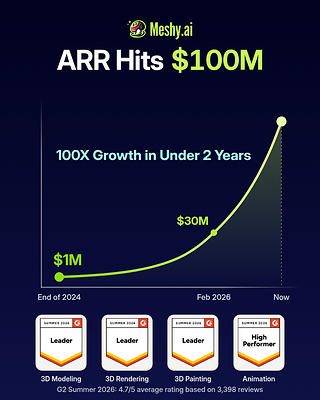
The milestone caps a period of rapid scaling across every dimension of the business. Meshy is now used by more than 15 million registered users and over 3,000 companies and educational institutions worldwide, who together have generated more than 100 million 3D models on the platform. Half of the world’s ten most valuable companies, by market capitalization or private valuation, are Meshy customers, and teams at 200 of the Fortune Global 500 build with Meshy.
Meshy launched the world’s first publicly accessible generative AI product for 3D in 2023, creating the category, and has led it ever since in model capability, user scale and revenue. This month, the company released Meshy 7.1, raising geometry generation to Ultra 4K resolution, and open-sourced its full alignment benchmark suite for image-to-3D generation: on both the geometry and texture benchmarks, Meshy 7 leads the industry, scoring 5.6 percentage points above the average of the latest comparable systems in end-to-end texture alignment. The $100 million milestone shows that the hardest frontier in multimodal AI now runs as a scaled, sustainable business. In July 2026, the company closed a nearly $400 million Series B at a $1.5 billion valuation, the largest funding round to date in AI 3D.
“Surpassing $100 million in ARR in under two years reflects the growing demand for AI-powered 3D creation,” said Faye Pan, VP of Growth at Meshy. “From game studios and film teams to educators and home 3D printing enthusiasts, our customers are showing just how broadly this technology can be used—and how much opportunity lies ahead. We’re grateful to the customers and creators who have trusted Meshy to bring their ideas to life. Their creativity and support have made this milestone possible.”
Understanding and generation: the division of labor behind the growth
Meshy’s climb from US$1 million to US$100 million in ARR coincided with the fastest two years of progress in general-purpose models, culminating in releases such as GPT-6 Astra. The two curves are connected: frontier models excel at understanding, planning and coding, while Meshy’s diffusion-based foundation models excel at generation, reconstructing every detail of a text prompt or an image into assets ready for a game engine or a 3D printer, typically in under a minute. A general model knows a face has two eyes; Meshy knows exactly how large those eyes should be. The two already work together in production: the spatial understanding of frontier models can drive Meshy’s API to turn a single image into a complete 3D scene, a workflow that was impossible a model generation ago.
The official Meshy mobile app is now live
Alongside the milestone, Meshy announced that its official mobile app is now available on iOS and Android. Powered by Meshy 7, the app turns photos, sketches and text into fully textured 3D models directly on a phone, with printability checks, AI repair, AR preview and export to industry-standard formats including STL, GLB, FBX, OBJ, USDZ and 3MF. Every creation syncs across web and mobile through a single Meshy account, and users can explore and remix models from the Meshy community.
The app makes 3D creation more accessible than ever: anyone can photograph an object, generate a model in about a minute, preview it in AR at real-world scale, and send it to a 3D printer, with the entire workflow running on a phone.
From AI for Work to AI for Fun
Meshy’s mission is an unlimited supply of fun powered by AI. Mora, the research architecture (Multimodal Open-world Real-time Architecture) it recently introduced, generates explorable, interactive worlds in real time; a publicly playable early demonstration, Mora 1, is live at mora.fun. The company’s first AI-native game, Black Box: Infinite Arsenal, generates in-game gear and combat mechanics from player prompts and makes its official public debut at Steam Next Fest at the end of 2026. Nearly all of the industry’s attention and resources today go to AI for work. Meshy is one of the earliest companies building for the phase after it, and among the best prepared.
“Much of AI’s early progress has focused on helping people work more efficiently. We see an equally exciting opportunity to help people create, express themselves and play,” Faye Pan added. “Across games, film and interactive worlds, AI is opening up new possibilities for both creators and audiences. Mora offers a glimpse of that future: worlds people can generate, explore and play in, all in real time. Our ambition is to make the possibilities for creativity and play limitless, and we’re building toward that vision step by step.”
About Meshy
Meshy builds multimodal foundation models for AI-powered 3D generation, turning text and images into production-ready 3D assets for games, film and 3D printing. Founded by Ethan Hu, who holds a Ph.D. from MIT, Meshy serves more than 15 million registered users worldwide. In July 2026, the company raised nearly $400 million in a Series B round at a $1.5 billion valuation, the largest round to date in AI 3D. Learn more at meshy.ai.
SOURCE Meshy


