

 |
A recent study by Natuvion and NTT Data Business Solutions shows that flexibility and AI are more than ever key success factors for IT transformations.
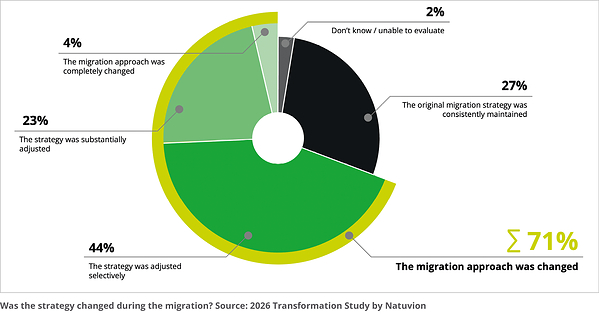
WALLDORF, Germany, Aug. 20, 2026 /PRNewswire/ — For the 2026 IT Transformation Study by Natuvion and NTT Data Business Solutions, more than 1,100 international executives and IT specialists worldwide were surveyed about their experiences with IT transformations. Two findings stand out: 71 percent of companies must adapt their migration methodology (greenfield, brownfield, or selective data transition) during the course of the project, and as many as 76 percent use AI during the transformation process.



Changes during migration process
The aim of the IT transformations was to strengthen innovation capabilities and increase flexibility
The study’s findings make it clear that transformations are an enterprise-wide issue through which management seeks to achieve specific goals. For example, 46 percent aim to boost innovation capacity, and 42 percent want to increase flexibility – even though flexibility is already a prerequisite for successfully executing a transformation. When asked to identify the factors to help them achieve these goals, 35 percent cited transformation expertise, 34 percent indicated data transparency, and 32 percent mentioned continuity within the project team.
AI is both a driver and a component of transformation
60 percent of the executives and IT specialists surveyed cite the adoption of modern technologies, such as AI, as the main driver of their IT transformation – a level that remains as high as it was the previous year (57 percent). While AI is gaining importance, traditional motivations, such as organizational adjustments, are becoming less and less important.
However, AI is not only the reason for IT transformations. It is also already being actively used by 76 percent of companies during the transformation process. Sixty-three percent already rely on AI for technical analysis and implementation; nearly 60 percent for data quality and migration; and 56 percent for strategic planning. The study thus demonstrates that AI is not only a goal but is also being used as a means to achieve it.
Poor-quality data remains a major problem
At the same time, business leaders are aware that AI can only be deployed successfully if the underlying data is of the highest possible quality. Yet, as in previous studies, 26 percent of companies cite poor data quality as a key problem and an unexpected challenge – for the fifth consecutive year. As a result, insufficient data quality once again tops the list of challenges. Inconsistent data, a lack of standards, and inadequate governance structures often go largely unnoticed in day-to-day operations – but they hit companies with full force during a transformation. As clean data is also a fundamental prerequisite for AI and data-driven business models, this issue evolves from a detailed operational problem into a strategic risk.
Legacy structures and major transformations bring challenges
39 percent of respondents cite the analysis of the existing IT landscape as the biggest challenge in the planning phase. This is followed by overall project complexity at 29 percent, meaning the real challenge lies not in the target architecture, but in dealing with the structures that have evolved over time, dependencies, and legacy issues. A deep understanding of the existing system landscape is therefore the underlying starting point for everything else.
44 percent of companies plan their transformation to take one to two years, and 53 percent typically budget between 5 and 50 million euros. Nevertheless, 82 percent exceed their budget, and just under 80 percent go over schedule. Since transformations cannot be handled linearly like a traditional project, it is important to build in buffers from the very beginning. A resilient project setup and the willingness to deal with uncertainty are not just “nice-to-haves” but rather minimum requirements for an IT transformation project.
Lessons for the future
Based on the experiences gained during the transformation, 34 percent of companies say they will use more AI next time. They also plan to focus on the most important processes (32 percent), improve communication (32 percent), and invest more in data quality (30 percent).
The study’s findings make it clear that IT transformations are taking on greater strategic importance. Topics such as artificial intelligence, innovation capacity, flexibility, autonomy, and security are now at the forefront and are fundamentally changing the role of IT. Transformation is thus no longer a purely technical discipline, but rather a leadership task.
Download the IT Transformation Study here: Transformation Study 2026
About Natuvion
Natuvion is a digital moving company. It does not transport tables, filing cabinets or chairs. Natuvion moves business-critical data and processes from one technological platform to another both smoothly and cost-efficiently. This enables Natuvion customers to always use data and processes on the most modern and innovative platforms.
Typical Natuvion “relocation services” include data migration, data transformation, data quality, data integration, data privacy, data security, and data governance. Natuvion’s experts are supported in the transformation of data by Natuvion DCS, a powerful software solution developed in-house. Natuvion is a founding member of the SAP Selective Data Transition Community and has been part of NTT DATA Business Solutions AG, a leading global SAP consultancy, since 2022. Featuring in the Inc. 5000 and FT 1000 lists, the Natuvion Group is one of the fastest growing software and IT consulting companies in Europe.
For more information, visit https://www.natuvion.com/de/

Usage of AI during transformation process

