


University collaborates with ASEAN to harmonize cross-border train systems
BEIJING, May 15, 2026 /PRNewswire/ — A news report from China Daily:


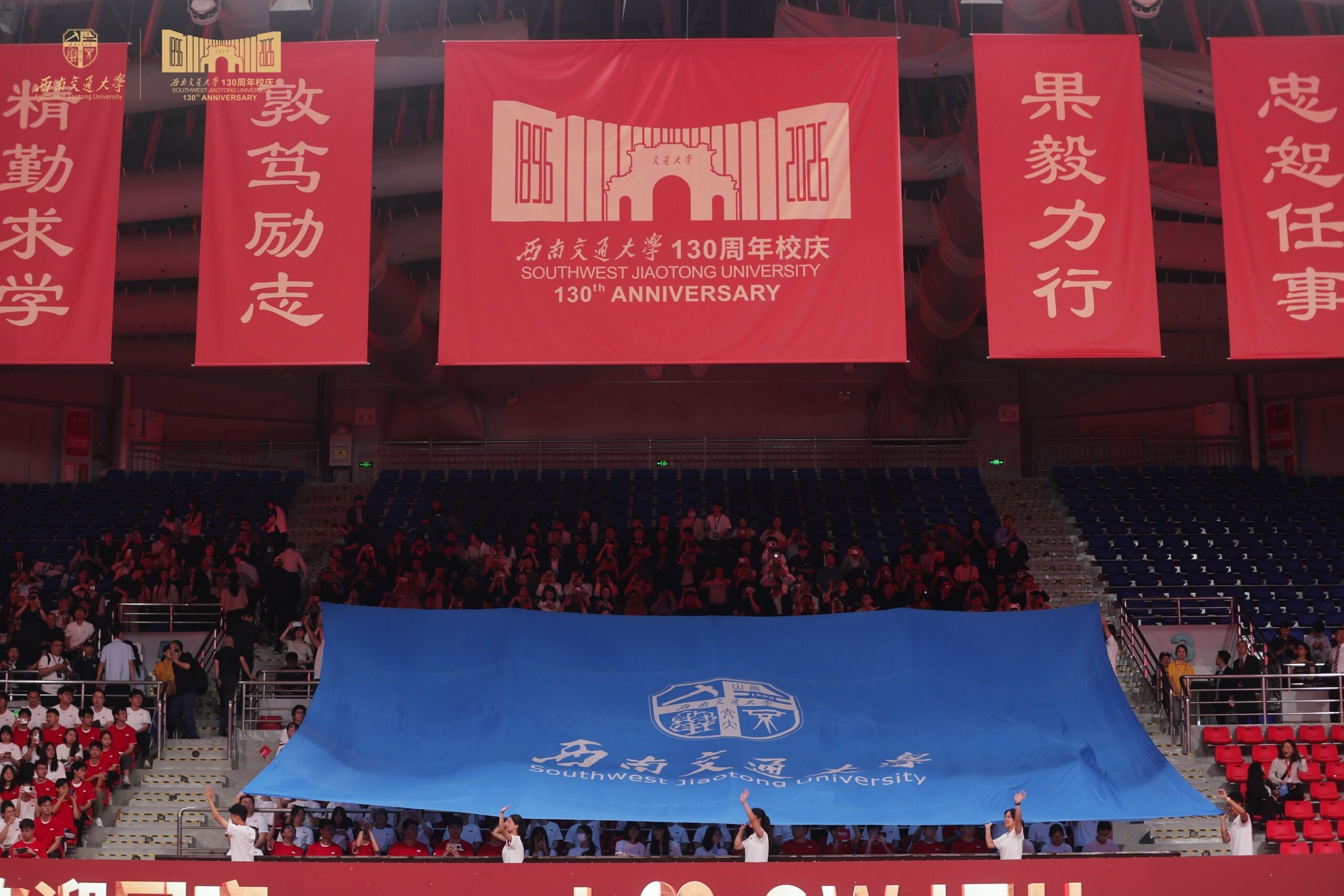
Southwest Jiaotong University celebrates its 130th anniversary with a grand ceremony at its Xipu Campus in Chengdu, Sichuan province, on May 15th. During the event, the university’s flag, which had traveled through 66 cities and regions and been held by approximately 1.3 million alumni, returned home after a yearlong journey.
As a prestigious institution in the field of rail transportation research and innovation, Southwest Jiaotong University has played a crucial role in the development of China’s rail infrastructure while fostering close ties with members of the Association of Southeast Asian Nations through enhanced regional connectivity.
Celebrating its 130th anniversary on Friday, SWJTU is recognized as the first institution of higher engineering education in China and is known as the country’s “cradle of railway engineers”. It has been instrumental in establishing the China-ASEAN Railway Interconnectivity Standards Cooperation Alliance, an international body dedicated to enhancing logistical efficiency by harmonizing railway practices across the region.
The alliance was co-founded by the university in collaboration with the Department of Railways under the Lao Ministry of Public Works and Transport, the Department of Standardization and Metrology under the Lao Ministry of Industry and Commerce, and the China-ASEAN Standardization Cooperation and Exchange Center. More than 30 governmental, industrial, academic and research institutions are involved in this collaborative initiative.
SWJTU and its fellow founding institutions provide the academic foundation for the alliance, which seeks to align rail transit standards between China and ASEAN member states. The initiative focuses on developing key technical benchmarks and a comprehensive standardization framework to create international standards for the region.
Pivotal to the alliance’s vision are education and research. Through collaborative training programs and academic exchanges, the alliance aims to prepare professionals to lead advancements in railway technology and bring the Trans-Asian Railway Network to fruition.
Timely response
The groundwork for the alliance was laid in June 2024. SWJTU partnered with the China-ASEAN Standardization Cooperation and Exchange Center and the Department of Standardization and Metrology under the Lao Ministry of Industry and Commerce to convene the first International Seminar on ASEAN Railway Interconnectivity Standardization. The seminar was held at SWJTU in Chengdu, the capital city of Sichuan province in Southwest China.
Delegates representing the railway and standardization authorities from China, Laos, Myanmar and Vietnam discussed how to strengthen ASEAN railway connectivity to bolster regional trade. They emphasized the need to increase bilateral and multilateral exchanges to integrate technical protocols and create a cohesive standards framework that supports collective growth.
The discussions also called for the institutionalization of frameworks for technological innovation and standards cooperation, notably the formation of a China-ASEAN rail transit industry alliance and a regional rail transit ecosystem. The experts reached a consensus on developing mechanisms for the mutual recognition of conformity assessments to ensure that technological advancements are shared across the region.
Alongside these technical frameworks, cultural exchange serves as a fundamental pillar for long-term collaboration. Committed to building a platform for talent cultivation, the partners agreed to establish an international training system featuring regular workshops and professional development programs. This endeavor will prepare specialists who possess the necessary skills to aid industrial growth and regional integration.
The China-ASEAN Railway Interconnectivity Standards Cooperation Alliance was conceived in response to burgeoning trade between China and ASEAN countries, where differing railway standards were constraining logistical efficiency.
Since the official launch of the China-ASEAN Free Trade Area in 2010, trade between China and the bloc has expanded significantly. In 2025, the total trade value reached 7.55 trillion yuan ($1.11 trillion), a year-on-year growth of 8 percent. The two sides have been each other’s largest trading partners for six consecutive years. This trajectory accelerated in the first quarter of 2026 as trade value hit 1.97 trillion yuan, marking a 15.4 percent year-on-year increase and accounting for 16.6 percent of China’s total foreign trade.
China has been scaling up its southern logistics corridors. Sichuan province exemplifies this progress, recording over 3,800 southbound international freight train journeys, including those along the New International Land-Sea Trade Corridor. These operations have yielded a cargo throughput of nearly 150,000 standard containers and a combined import and export value exceeding 10 billion yuan.
On June 12, 2025, the alliance was officially launched at the second Belt and Road Conference on Science and Technology Exchange in Chengdu.
“Southeast Asian rail networks primarily use meter-gauge tracks (which are narrower than the standard gauge), and supporting infrastructure, such as electrical and communication networks, uses different standards than those in China,” explained Zhu Minhao, dean of SWJTU’s Institute of Traffic Safety Technology. He noted that without uniform railway standards, freight would need to be transshipped between different vehicles, increasing logistics and transit times.
Technical interoperability is indispensable for enhancing the efficiency, safety and sustainability of rail transit systems. As a vital conduit for deepening international cooperation, it necessitates the concerted efforts of governments, research institutions and industry stakeholders.
In pursuit of high-quality, shared development under the Belt and Road Initiative, the “hard connectivity” of rail transit infrastructure should be complemented by the “soft connectivity” of rules and standards. The establishment of the China-ASEAN Railway Interconnectivity Standards Cooperation Alliance is a timely response to this need. By harmonizing railway standards, the alliance aims to eliminate logistical bottlenecks, reduce transportation costs and increase the efficiency of cross-border trade.
Zhu noted that the alliance will focus on promoting “hard connectivity” through infrastructure development to integrate transportation networks, while advancing “soft connectivity” through the synchronization of technical protocols. “Using the standardization framework of China’s national railway as a foundation, the alliance aims to assist ASEAN countries in establishing their own independent standard systems,” he added.
Ultimately, this collaborative effort functions as a cornerstone for regional economic integration, solidifying the BRI’s vision and translating it into tangible, long-term prosperity for all participating nations.
Proven model
The alliance is built on the success of the China-Laos Railway, a model for railway connectivity between China and ASEAN. Since the line became operational in 2021, economic and cultural exchanges between China, Laos and other ASEAN member states have continuously flourished. Furthermore, the initiative has catalyzed progress in standardization cooperation between China and Laos, with the railway acting as the primary focal point for technical alignment.
As a railroad jointly constructed and operated by two countries, the successful operation of the China-Laos Railway owes much to the alignment of standards. Built to China’s national railway standards, the railway employs a 1,435-millimeter standard gauge with rails weighing approximately 60 kilograms per meter. This allows uninterrupted transit between the two nations via a single train journey.
The China-Laos Railway has increased both the volume and diversity of trade between the two countries. As of April, the line had operated a total of 21,000 train journeys, with total cargo volume exceeding 18.6 million metric tons. The variety of goods now surpasses 3,800 types, reaching 31 provincial-level regions in China as well as countries including Laos, Thailand and Vietnam.
During the first quarter of 2026, the import and export trade value via the China-Laos Railway totaled 6.81 billion yuan, increasing by 62.7 percent year-on-year. From Jan 1 to April 26, imported durian shipments on this route amounted to 50,300 tons, marking a year-on-year surge of 94.2 percent.
Once considered a luxury fruit, durians have now become an accessible treat for average households. The China-Laos Railway has upgraded the logistical operations of fruit transport, providing a reliable rail link between Southeast Asia’s orchards and Chinese consumers’ dining tables.
These figures substantiate the increasing presence of Southeast Asian tropical fruits in the Chinese market while underscoring the railway’s role as a corridor that propels cross-border agricultural trade and bilateral cooperation.
With the China-Laos Railway setting an example, ASEAN countries are accelerating efforts toward regional connectivity. This is evidenced by the 2023 launch of the Jakarta-Bandung High-Speed Railway in Indonesia and the progress on the China-Thailand Railway, which is designed to connect with Laos. Aligned through standardized systems, these projects will provide critical support for the China-Laos-Thailand Economic Corridor.
Concerted effort
The China-ASEAN Railway Interconnectivity Standards Cooperation Alliance is a concerted international effort, with SWJTU playing a key role as a principal initiator. The alliance’s inaugural plenary meeting, held on Sept 17, 2025, in Nanning, Guangxi Zhuang autonomous region, ratified the alliance’s charter and instituted its organizational framework.
A council was formed, comprising representatives from governmental bodies, universities, research institutions, third-party organizations and railway design providers from China, Laos, Thailand, Cambodia, Myanmar and Vietnam. SWJTU President Yan Xuedong was elected the alliance’s first rotating chairman. Zhu from the university’s Institute of Traffic Safety Technology was appointed the alliance’s secretary-general and director of the standardization technology committee.
During the plenary meeting, Yan emphasized that the alliance’s formation signifies a milestone in China-ASEAN rail transit standardization cooperation. “As a principal founding institution, SWJTU will utilize its academic, research and talent cultivation capabilities to advance research on international standards, the application of research results in enhancing regional connectivity, and collaboration with ASEAN partners,” Yan said. “Our goal is to cultivate international professionals and build a model for rail transit standardization cooperation to drive regional development.”
Dexanourath Seneduangdeth, president of the National University of Laos, expressed hope that, under the guidance of the China-ASEAN Strategic Partnership Vision 2030, all stakeholders could jointly formulate a blueprint for collaboration on rail transit standardization to build a closer China-ASEAN community with a shared future.
Anousone Thipduangchai, deputy director of the Department of Standardization and Metrology under the Lao Ministry of Industry and Commerce, said the establishment of the alliance would facilitate the exchange of expertise in rail transit construction, operation, management and standardization, thereby optimizing the technical integrity of the regional rail transit system and driving trade growth in the China-ASEAN region.
Deng Junqiao, deputy general manager and chief engineer of China Railway Eryuan Engineering Group, voiced his hope that all parties would uphold the principles of openness, inclusivity, cooperation and mutual benefit. He emphasized the importance of working together to achieve efficient rail connectivity across ASEAN to forge a closer China-ASEAN community.
During the meeting, a tripartite cooperation agreement was signed among SWJTU, the National University of Laos, and the Department of Railways under the Lao Ministry of Public Works and Transport. The signatories pledged to launch joint training programs for undergraduate, master’s and doctoral students, as well as short-term training and capacity-building programs. In addition, a platform for joint research and standard formulation will be created.
Lu Chunfang, an academician of the Chinese Academy of Engineering, highlighted that standardization is a foundational task essential to railway connectivity among ASEAN countries. “The formulation of standards is a prerequisite, yet the key to connectivity lies in their effective implementation,” Lu said. He commended the alliance for converging resources from governments, industries, academia and research institutions across China and ASEAN, bringing together collective expertise to develop a more structured and practical standard system.
SWJTU’s leadership in the alliance demonstrates its commitment to fostering international collaboration and innovation in the rail transit sector. As the university celebrates its 130th anniversary, its contributions to the BRI attest to the enduring significance of education, research and standardization in building a more connected and prosperous world.

