

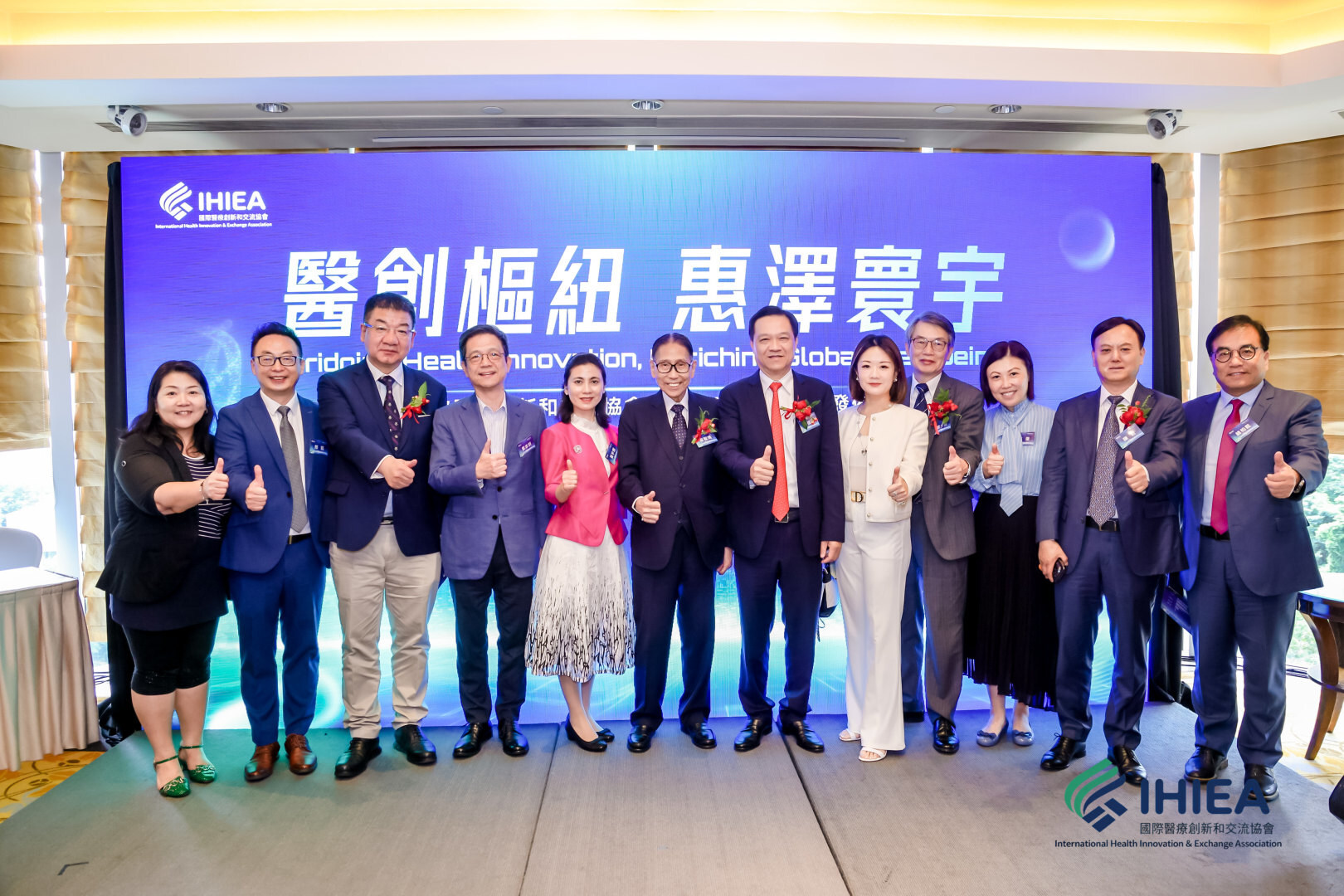
Focusing on cross-border healthcare, continuing medical education, innovation translation, Global Medical Excellence Center certification, data collaboration and standards for emerging technologies
HONG KONG, June 29, 2026 /PRNewswire/ — The International Health Innovation & Exchange Association (IHIEA) held its launch press conference in Hong Kong today, formally announcing the platform’s establishment and unveiling its future-oriented Six-Point Action Blueprint. Based in Hong Kong, connected to the Guangdong-Hong Kong-Macao Greater Bay Area, oriented toward Asia and linked with the world, IHIEA aims to build an international collaborative platform for healthcare innovation that connects clinical practice, research, industry, capital, regulatory systems and payment mechanisms, helping medical innovations be translated into clinical and social value more efficiently, safely and sustainably.



On the occasion of the Association’s establishment, Mr John KC Lee, Chief Executive of the Hong Kong Special Administrative Region, sent an inscription to offer encouragement: “With brilliant strategy and great talent, benevolence reaches the four seas; With new vision and fine medicine, blessings spread to all directions.” At the press conference, Dr Leong Che Hung, GBM, GBS, OBE, JP, former Chairman of the Hospital Authority, attended as Honorary Chairman of IHIEA, joining distinguished guests from healthcare, academia, industry and public affairs to witness the formal launch of IHIEA.
IHIEA Co-founder and CEO Mr Dennis Lu said at the press conference that IHIEA was not established to add another “microphone” to the healthcare sector, but to build a “central processor” that genuinely addresses industry pain points. Through systematic integration of resources, IHIEA seeks to promote high-quality collaboration across critical links in the medical innovation chain.
He noted that the global healthcare industry is entering a period of deep restructuring. Demand for cross-border healthcare continues to grow, while frontier biotechnology, AI healthcare and real-world data are advancing rapidly. At the same time, the tension between the speed of technological development and the building of institutions, standards and trust systems is becoming increasingly apparent. “Technology is advancing faster and faster, while trust is being built more and more slowly; there are more and more breakthroughs in laboratories, but the outcomes that truly reach patients remain limited,” he said.
He pointed out that the core question facing medical innovation today is no longer “how to invent a new technology”. Rather, it is about building a sustainable, executable, and accountable coordination mechanism and social contract around key links such as investment, validation, regulation, pricing, payments, and broad-based adoption. IHIEA was created in this context, with the goal of helping medical innovation migrate from “concept formation” to being “clinically usable, system-governable, publicly trusted and service-accessible”.
Mr Lu further explained that Hong Kong has unique strengths in this process. Hong Kong not only has an international professional services system, a rule-of-law and compliance environment, but also forms close synergies with the Guangdong-Hong Kong-Macao Greater Bay Area, combining the ability to align with international standards with the advantages of Asian clinical application scenarios. “Hong Kong’s value lies not only in connecting the world, but also in adding value to innovation and validating it for the world,” he said. In the future, Hong Kong should not only serve as a transit point for innovation resources, but also become a calibrator of medical standards, an accelerator for translational outcomes and an amplifier of industry trust.
Around these objectives, IHIEA announced that it will fully advance the following six key action areas:
1. Upgrading Cross-Border Healthcare Services
IHIEA will support Hong Kong in developing into a major Asia-Pacific hub for high-quality international medical tourism and medical exchange. It will promote higher-level integration between premium healthcare services and regional resources, and improve the overall standard of cross-border healthcare across processes, standards, service experience, and compliance. IHIEA believes that the key to cross-border healthcare is not only “bringing patients in”, but also “coordinating action and building a system of trust”.
2. Building an International Continuing Medical Education (CME) Hub
IHIEA will actively support Hong Kong in building a continuing medical education platform that serves the Asia-Pacific and connects with the world. The platform will bring together frontier medical knowledge, clinical standards and professional training in Hong Kong and extend them to Asia-Pacific markets, further strengthening Hong Kong’s international influence in medical education and professional capacity building, and meeting the needs of tens of millions of doctors and nurses across Asia-Pacific.
3. Building a Regional Medical Innovation Translation Ecosystem
Focusing on key links such as innovative technology incubation, translational medicine, the regional establishment of international unicorn enterprises, multi-center clinical trials in the Greater Bay Area, approval coordination and payment connectivity, IHIEA will promote a more complete, efficient and resilient innovation translation system, enabling research outcomes to move more smoothly from laboratories into clinical practice and patient care.
4. Advancing the GMEC Assessment and Certification System
IHIEA will work with relevant institutions to advance the GMEC (Global Medical Excellence Center) Assessment and Certification System, and explore the establishment of a cross-regional, benchmarkable, quantifiable and continuously improving evaluation framework for medical excellence centers. This will help high-level clinical services and hospital management capabilities move toward higher international standards.
5. Exploring an “International Medical Data Hub” Cooperation Framework
Leveraging Hong Kong’s institutional and locational advantages, IHIEA will explore high-quality medical data collaboration in line with the principles of usability, control, traceability, and accountability. This will help real-world data better serve scientific research, clinical practice, approvals, payment and health management, while increasing data value and public trust in parallel.
6. Leading Standards Development for Emerging Medical Technologies
In emerging fields such as AI healthcare and frontier biotechnology, IHIEA will work with academia, industry, and relevant professional communities to advance standards, systems, ethical consensus, and responsibility frameworks. IHIEA believes that standards should not become an obstacle to innovation but should serve as a runway, providing clear boundaries and long-term support for the healthy development of new technologies.
Notably, as an important initiative for IHIEA to serve Hong Kong society and help shape healthcare trends in Asia-Pacific, the International Heart Failure and Cardiomyopathy Committee, a specialized committee under IHIEA, was also launched in Hong Kong on the same day. Bringing together renowned medical experts and scholars from China and overseas, the committee marks a substantive step forward for IHIEA in promoting frontier exchange and standards development in specialized medical fields.
At the press conference, Mr Lu made three public commitments on behalf of IHIEA: first, the cooperation IHIEA promotes must be “verifiable”, based on evidence, metrics and outcomes; second, the standards IHIEA advocates must be “executable”, capable of entering real-world settings and solving real problems; and third, the resources IHIEA connects must be “accountable”, with compliance and ethics always serving as prerequisites.
He emphasized that IHIEA will not focus only on how many events it organizes or how many partnerships it signs, but on whether it can genuinely help the industry form new consensus and collaboration mechanisms, and establish a more mature, reliable and sustainable balance between innovation and safety, efficiency and fairness, commercial return and medical ethics.
“Truly mature medical innovation is not only about whether something can be developed. It must also be affordable, governable, trusted and financially accessible,” he explained. “The destination of medical progress has never been the demonstration of technology itself. It is to ensure that every ordinary person, at life’s most vulnerable moments, still has dignity, choice and hope.”
Mr Lu said the formal establishment of IHIEA marks the launch of a future-oriented framework for medical innovation collaboration. Going forward, IHIEA will continue to make innovation its foundation, Hong Kong its anchor, standards its pathway and trust its goal, working with more partners to promote the high-quality development of the regional healthcare industry.
About the International Health Innovation & Exchange Association
The International Health Innovation & Exchange Association (IHIEA) is a Hong Kong-headquartered non-profit international academic and industry collaboration organization. IHIEA brings together leading institutions and professionals from the global healthcare industry, academia and investment community, and is committed to building an internationally influential platform for healthcare innovation and development. IHIEA aims to advance international cooperation and standards development for emerging medical technologies, empower the industry, partners and the wider community of healthcare professionals, ultimately improve public health and wellbeing, and provide innovative solutions to global and regional healthcare challenges.
 View original content to download multimedia:https://www.prnewswire.com/apac/news-releases/international-health-innovation–exchange-association-ihiea-launches-in-hong-kong-and-unveils-six-point-action-blueprint-302812848.html
SOURCE International Health Innovation & Exchange Association (IHIEA)
