


 |
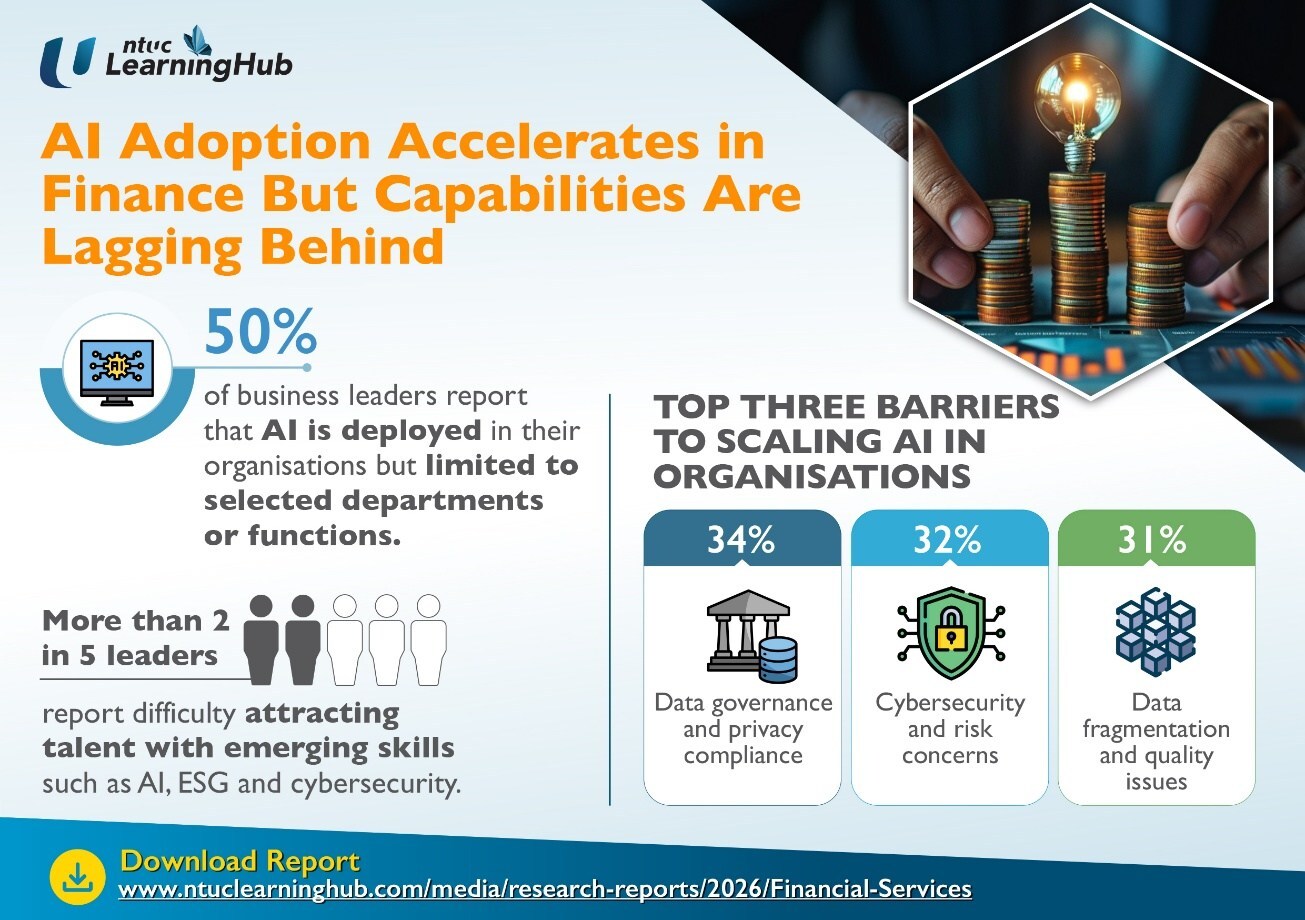
- Half (50%) of business leaders from the financial services sector report that AI is deployed in their organisations but limited to selected departments or functions, while a combined 20% are either still in an exploratory stage (11%) or have no concrete plans for adoption (9%).
- Leaders cite data governance and privacy compliance (34%), cybersecurity and risk concerns (32%), data fragmentation and quality issues (31%), regulatory uncertainty around AI use (30%), and shortages in AI talent and technical expertise (30%) as the main barriers preventing AI from being deployed at scale in the sector.
- More than two in five leaders (42%) report difficulty attracting talent with emerging skills such as AI, ESG and cybersecurity, while 39% say they struggle to upskill existing employees at the required pace by regulatory and market changes.
- Finance leaders identify AI and machine learning expertise as the most critical capability to develop (46%), yet is also cited as the most lacking (34%). Other critical skills for the sector include cybersecurity (41%) and AI governance and ethical AI practices (38%).
SINGAPORE, April 17, 2026 /PRNewswire/ — While financial institutions are adopting Artificial Intelligence (AI), workforce capabilities are struggling to keep pace. Additionally, AI adoption has yet to be scaled consistently across organisations, with half (50%) of business leaders surveyed reporting that AI is deployed in their organisations but is limited to selected departments or functions, while a combined 20% are either still in an exploratory stage (11%) or have no concrete plans for adoption (9%).
While business leaders identify AI adoption (63%) as the driver with the greatest workforce impact in the coming two years, there are barriers to deploy AI at scale in the sector. They cite data governance and privacy compliance (34%), cybersecurity and risk concerns (32%), data fragmentation and quality issues (31%), regulatory uncertainty around AI use (30%), and shortages in AI talent and technical expertise (30%) as the main barriers to AI-scaling.



These are some of the key findings from NTUC LearningHub’s Industry Insights Report on Financial Services, which surveyed 200 business leaders to examine how technological change, sustainability priorities and workforce capabilities are shaping the future of the industry.
Against this backdrop, workforce readiness emerged as a key challenge. More than two in five leaders (42%) report difficulty attracting talent with emerging skills such as AI, Environmental, Social, and Governance (ESG) and cybersecurity, while 39% say they struggle to upskill existing employees quickly enough to keep pace with regulatory and market changes.
Beyond talent availability, the report also points to capability gaps within the financial services sector. Business leaders identify AI and machine learning expertise as the most critical future capability (46%), yet more than one-third of leaders (34%) say it is currently lacking in their workforce. Other skills business leaders believe are critical to develop in the sector include cybersecurity (41%) and AI governance and ethical AI practices (38%), fraud and financial crime prevention (34%), and risk management (31%).
In response to these challenges, organisations in the sector are stepping up their investment in training and development. More than one-third of business leaders (37%) report having sent employees for financial services-related training in the past two years, while 50% of leaders say they plan to do so within the next one to two years, signalling a strong intent to strengthen workforce capabilities. This emphasis in workforce development is reinforced by broad recognition of formal credentials, with more than four in five business leaders (25% very important, 59% quite important) acknowledging the importance of industry-recognised certifications in validating employee competencies.
At the same time, business leaders recognise that workforce development must extend beyond technical capabilities. They also identify a continuous learning mindset (41%), critical thinking (40%), and creativity in product and service innovation (39%) as the top human skills for professionals in the financial services to develop.
Commenting on the report’s findings, Mr Tay Ee Learn, Assistant Chief Executive and Chief Sector Skills Officer, NTUC LearningHub, says, “AI is already being used across many parts of the financial services sector, but widespread usage alone does not automatically translate into productivity or competitive advantage. The findings show that the real challenge lies in scaling AI responsibly across the organisation, where gaps in talent, governance and data capabilities continue to hold teams back. For organisations, especially small and medium‑sized firms, AI can be a powerful tool but only if employees are equipped with the right technical, governance and human capabilities. Structured upskilling that integrates AI and data expertise, cybersecurity, ethical AI practices and critical thinking is essential to help organisations move beyond pilots and unlock measurable business impact. This is where targeted training and industry‑recognised certifications play a vital role in building the capabilities needed to make AI work at scale.”
To download the Industry Insights Report on Financial Services, please visit https://www.ntuclearninghub.com/media/research-reports/2026/financial-services. To find out more about the courses, training, and grants, please contact NTUC LearningHub at www.ntuclearninghub.com.
About NTUC LearningHub
NTUC LearningHub is the leading Continuing Education and Training provider in Singapore which aims to transform the lifelong employability of working people. Since our corporatisation in 2004, we have been working with employers and individual learners to provide learning solutions in areas such as Infocomm Technology, Generative AI & Cloud, Healthcare, Retail & Food Services, Employability & Literacy, Business Excellence, Workplace Safety & Health, Security, Human Resources & Coaching and Foreign Workers Training.
To date, NTUC LearningHub has helped over 34,000 organisations and achieved more than 3.2 million training places across more than 1,000 courses with a pool of about 1,000 certified trainers. As a Total Learning Solutions provider to organisations, we also forge partnerships to offer a wide range of relevant end-to-end training. Besides in-person training, we also offer instructor-led virtual live classes (VLCs) and asynchronous online learning. The NTUC LearningHub Learning eXperience Platform (LXP)—a one-stop online learning platform—offers timely, bite-sized and quality content for learners to upskill anytime and anywhere. Beyond learning, LXP also serves as a platform for jobs and skills development for both workers and companies.
For more information, visit www.ntuclearninghub.com.

