

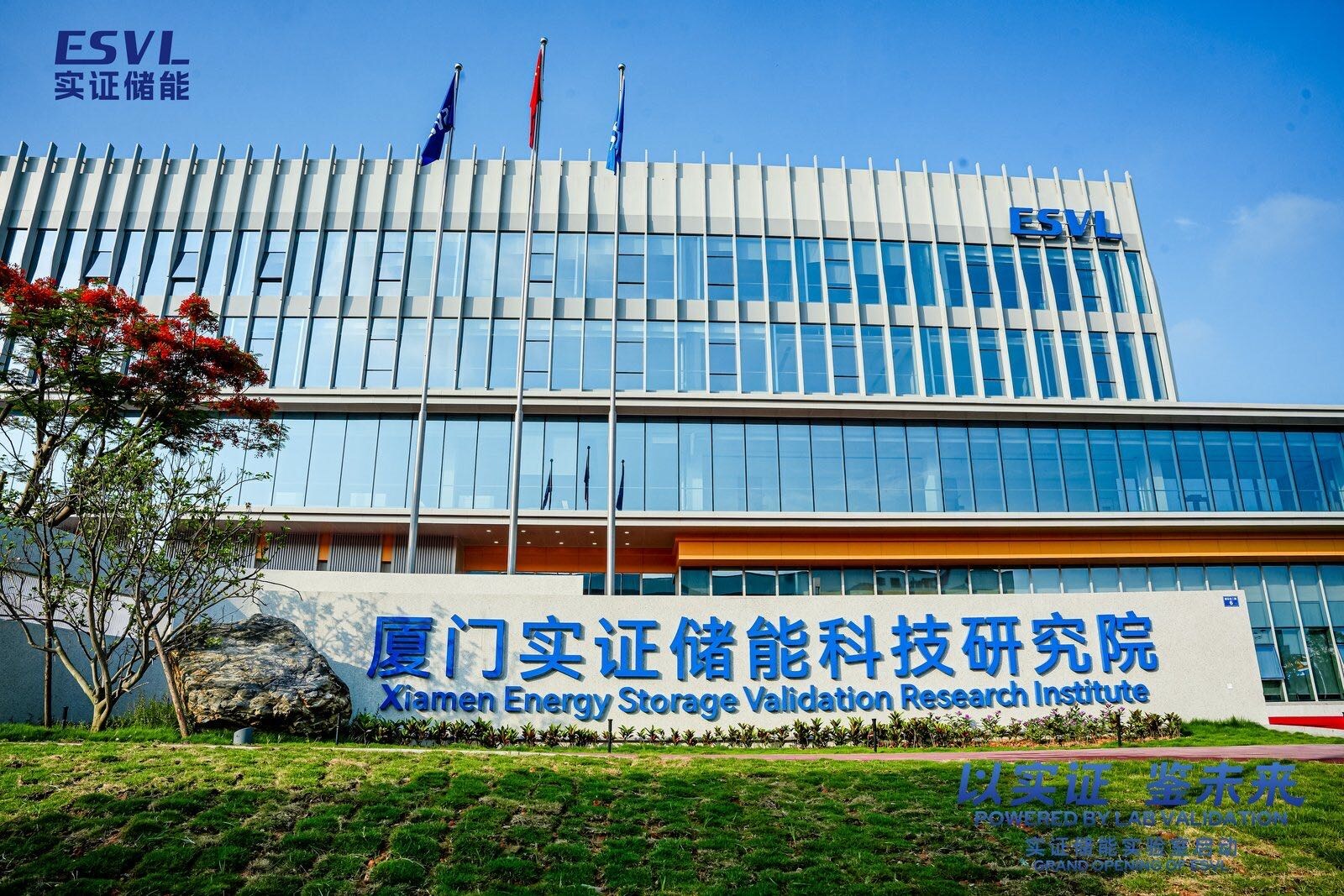
XIAMEN, China, May 28, 2026 /PRNewswire/ — CATL’s Xiamen Energy Storage Validation Research Institute (ESVL), the world’s largest and most comprehensive one-stop testing and validation platform in the industry, officially commenced operations on May 28, marking a major step into the era of real-world validation for the industry.

Spanning 10 hectares and backed by an investment of roughly RMB 3 billion (about 440 million U.S. dollars), the proving ground is designed as an open and shared infrastructure accessible to all players in the global energy storage sector.
The Imperative for Real-World Validation
As energy storage scales rapidly as a core enabler of the global energy transition, the industry is facing a widening gap between installed capacity and real-world performance. Nearly one in five large-scale energy storage power stations worldwide are underperforming, while 46.5% of energy storage systems experience grid-connection delays of more than two months. With validation capabilities still largely limited to component and scenario testing, the industry increasingly needs a more credible station-level validation framework.
Real-world validated energy storage is built on the premise of the grid’s most demanding operating conditions. It moves validation from component-level testing to full-system and station-level verification, covering safety, grid-support capability and long-term reliability before deployment.
“Scientific rigor is more critical than ever as energy storage enters the gigawatt era,” said Dr. Wu Kai, Chief Scientist of CATL. “That means being honest about equipment performance, respectful of grid dynamics and disciplined in testing results — while raising industry quality standards to the station level and bringing validation forward to the pre-delivery stage. ESVL is designed to reflect that rigor, and to help usher in a more trusted and sustainable era of real-world validation.”
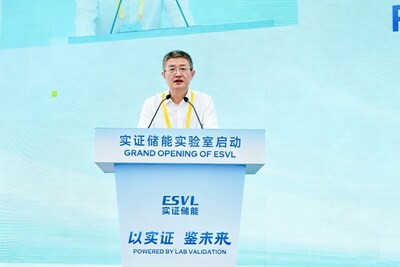
“ESVL is open to the global energy storage industry and works with leading certification bodies, including TÜV SÜD, TÜV Rheinland, CGC and CSA, to provide one-test, multi-witness, globally recognized services,” said Dr. Chen Xiaobo, Head of ESVL. “As energy storage increasingly becomes a critical infrastructure asset, ESVL’s independent, traceable real-world validated data can help regulators make evidence-based decisions, insurers price risk more precisely and financial institutions assess energy storage as a more credible, bankable asset.”
Five Core Laboratories Deliver Full-Scenario Validation
ESVL is built around five innovative laboratories and marks multiple global firsts.
Grid connection that mirrors real-world grids. The world’s first station-level grid integration laboratory is equipped with a 35kV/100MVA grid simulator and a real-time simulator, 14 times larger than NREL’s 13.8kV/7MVA platform, setting a new global benchmark for grid‑level testing. It can test more than 10 large-scale energy storage containers at the same time, simulate 1,000-node grid topologies, and cover a frequency range of 15 Hz to 60 Hz. It can also validate station-level grid-forming capability and multi-unit coordination under complex grid conditions, helping improve commissioning safety and shorten commissioning cycles.
High-voltage failures traced to the root cause. Covering 1kV to 500kV, the High-Voltage Safety Laboratory can help investigate the underlying mechanisms of fire and explosion under extreme high-voltage conditions, including lightning impulses, power-frequency and DC withstand voltage, and partial discharge testing. By identifying the safety boundaries of key components and full systems, it helps guide equipment design toward preventing fire and explosion.
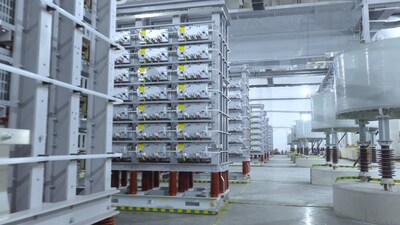
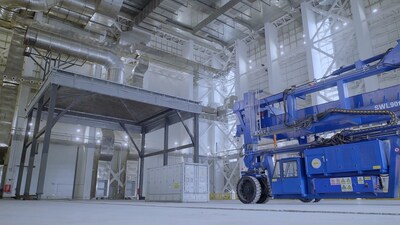
Controlled combustion testing at scale. The Thermal Safety and Combustion Laboratory is the world’s first large indoor combustion facility equipped with a 20MW calorimeter. With 100,000 cubic meters of indoor combustion space, it can carry out explosion testing on nine large energy storage containers at the same time. It provides critical data for assessing safety spacing, deployment planning and system iteration.
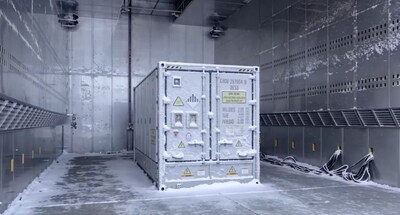
Reliability proven in extreme climates. Equipped with climate, environmental, salt spray, rain and sand chambers, the Environment Reliability Laboratory can verify full-system energy storage containers under extreme conditions ranging from -50°C to 100°C and simulated high-altitude pressure environments up to 7,200 meters. It helps validate long-term performance under desert heat, high-altitude low pressure, coastal salt spray and other harsh environments.
EMC testing under real operating conditions. The Electromagnetic Compatibility Laboratory is the world’s only facility capable of accommodating a full 40-foot container, equipped with a 65-ton turntable and a 5MW power supply, and able to perform EMC testing in an anechoic chamber under real high-power charge and discharge conditions. By replicating real operating conditions, it helps identify electromagnetic interference risks before deployment and improve communication and control reliability.
CATL’s Proven Record in Real-World Projects
CATL’s leadership in real-world validated energy storage is rooted in years of operational experience. In 2016, the company began developing 100 MWh-class lithium-ion battery energy storage technology, which led to a breakthrough in long-life zero-degradation technology in 2020 and the deployment of a 30 MW/108 MWh energy storage station in Jinjiang, China.
Since then, CATL has expanded its energy storage footprint globally, including the Quinbrook project in Australia and a large solar-plus-storage project in North America that later secured refinancing at a lower interest rate. In 2025, CATL’s energy storage battery sales reached 121 GWh, with a global market share of 30.4%, ranking No. 1 worldwide for five consecutive years.
By combining continuous technological innovation, proven long-term project performance, and robust system-level validation capabilities, CATL is defining a new trust framework for the global energy storage industry.
SOURCE CATL


