

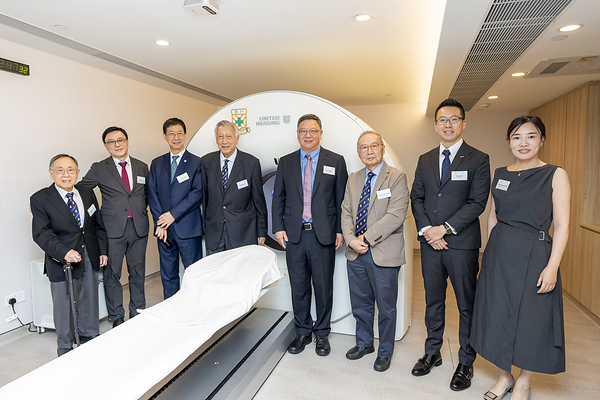
HONG KONG, Sept. 23, 2026 /PRNewswire/ — HKSH Medical Group (HKSH) and United Imaging Healthcare (United Imaging) announced on September 23 the arrival of Hong Kong’s first long-axial PET/CT, the uMI Panorama GS, at HKSH Cancer Centre, providing a new technology platform for molecular imaging clinical applications and research in Hong Kong.

HKSH Medical Group (HKSH) and United Imaging Healthcare (United Imaging) announced on September 23 the arrival of Hong Kong’s first long-axial PET/CT, the uMI Panorama GS, at HKSH Cancer Centre.

As one of Hong Kong’s leading private hospitals, HKSH brings more than a century of clinical experience and has long been committed to advancing precision medicine, actively adopting innovative technologies and promoting clinical research in cancer diagnosis to enable more precise clinical diagnosis and treatment planning.
Mr. Wyman Li, Governor of The Li Shu Fan Medical Foundation, Chief Operating Officer of HKSH Medical Group and Director of Hong Kong Sanatorium & Hospital, said: “Precision cancer care is at the core of HKSH’s development while advanced imaging diagnostics is an indispensable part of precision medicine. HKSH established Asia’s first clinical PET center in 1999. Today, HKSH operates 5 medical cyclotrons and 3 PET laboratories capable of producing more than 30 types of positron-emitting tracers and radiopharmaceuticals, making it one of the few cancer centers in the region with comprehensive nuclear medicine services. “
As the world’s first medical institute to use dual-tracer PET with ¹¹C-acetate and 18F-FDG mainly for the detection of hepatocellular carcinoma (HCC)[1], renal cell carcinoma[2] and myeloma[3], HKSH leverages the complementary properties of the two tracers to address the diagnostic limitations associated with the relatively low sensitivity of conventional tracers in the early stage of these tumors.
Accurately capturing molecular information from tumors depends not only on the role of tracers, but also on the capabilities of advanced imaging technologies. Dr. Garrett Ho, Head of Department of Nuclear Medicine and PET of HKSH, noted, “The Center currently has a range of tracers targeting different tumor characteristics. Combined with advanced imaging technologies, these capabilities enable a more comprehensive visualization of both small primary lesions at an early stage and metastatic lesions throughout the body, providing important information to support the formulation of precision treatment strategies.” The introduction of the uMI Panorama GS will provide broader technical support for HKSH’s ongoing PET research across multiple areas. With a 148 cm ultra-long axial field of view, leading spatial resolution, and ultra-high sensitivity, the system can expand PET scan coverage while enhancing the efficiency of tracer signal acquisition. Combined with high-quality imaging, its extended whole-body coverage can help capture a more comprehensive view of lesions and molecular targets reflected by molecular tracers, supporting disease staging, whole-body lesion assessment, and treatment response evaluation.
uMI Panorama GS also enables reduced patient radiation exposure while preserving consistent, high-quality image quality and significantly shortening scan duration. For pediatric and other radiation-sensitive patients, shorter scan time can also mitigate challenges related to patient compliance, enabling a more efficient, patient-centric PET imaging workflow. All these advantages, together with much-improved electronics and algorithms, contribute to the capability of tracer dynamic studies. The addition of a time variable can resolve different phases of tracer interaction with the target organ or tumors.
Since May 2025, HKSH and United Imaging have been engaged in a strategic collaboration focused on advanced CT technologies and clinical applications. With Hong Kong’s first long-axial PET/CT now at HKSH, the collaboration will continue to deepen between clinical needs and technological innovation.
Mr. Wyman Li said: “The introduction of the Total-Body PET/CT system is not an upgrade of equipment but rather a new generation of PET/CT scanners, enabling further integration of HKSH’s extensive clinical experience with United Imaging’s advanced R&D capabilities, bringing safer, more efficient and personalized cancer diagnosis and treatment to patients in Hong Kong and the Greater Bay Area.”
Dr. Jun Bao, President of United Imaging Healthcare said: “United Imaging has always believed that the value of medical imaging innovation lies in addressing real clinical needs and creating meaningful value for patients. Looking ahead, we look forward to working with HKSH to bring advanced molecular imaging technologies to more patients in Hong Kong.”
In alignment with United Imaging’s mission to broaden access to advanced care worldwide, Hong Kong connects global advances in care with diverse clinical practices, providing a vital setting for the application of innovative medical imaging technologies.
Dr. Jusong Xia, President of International Business, United Imaging Healthcare, said: “Working with leading healthcare institutions around the world is an important part of United Imaging’s international development. The introduction of Hong Kong’s first long-axial PET/CT at HKSH reflects the deep integration of United Imaging’s technological innovation with local clinical expertise, and demonstrates how advanced imaging technologies can be better integrated into different healthcare systems and clinical practice.”
|
1. Ho CL, Yu SC, Yeung DW. 11C-acetate PET imaging in hepatocellular carcinoma and other liver masses. J Nucl Med. 2003;44(2):213-221. |
|
2. Ho CL, Chen S, Ho KM, et al. Dual-tracer PET/CT in renal angiomyolipoma and subtypes of renal cell carcinoma. Clin Nucl Med. 2012;37(11):1075-1082. |
|
3. Ho CL, Chen S, Cheng T, Leung YL, Wong KK. Preliminary assessment of 11C-acetate and 18F-FDG PET/CT for the diagnosis and management of multiple myeloma. J Nucl Med. 2011;52(suppl 1):369. |

