

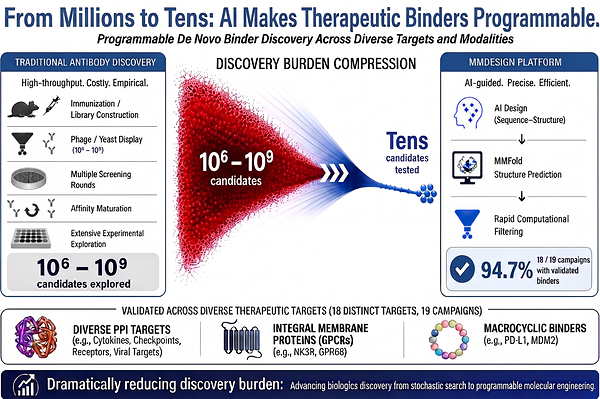
SHANGHAI, Nov. 3, 2026 /PRNewswire/ — MoleculeMind, an AI-native biological infrastructure company, recently released a new technical report detailing the performance of MMDesign, its AI-powered de novo molecular design platform which demonstrated a 94.7% campaign success rate across diverse biological targets and molecular modalities. The report presents experimental validation results from 19 design campaigns spanning 18 distinct targets and two molecular modalities: nanobodies and macrocyclic peptides. Eighteen campaigns yielded experimentally confirmed binding molecules, with only 9 to 50 candidates tested per campaign. Notably, MMDesign successfully generated binders against all six of the challenging G protein-coupled receptor (GPCR) targets evaluated and achieved a 100% candidate hit rate for NK3R. The findings demonstrate how AI-driven molecular discovery is evolving from isolated design successes towards a reusable, scalable R&D approach that combines computational generation, intelligent candidate selection, and targeted experimental validation.
High success rates with limited experimental screening


Traditional antibody discovery commonly relies on animal immunization and large-scale library screening. These approaches can explore millions or billions of molecular candidates, but identifying promising binders requires substantial experimental resources. MMDesign offers a complementary approach by generating new molecular sequences computationally and prioritizing a small number for laboratory testing. Representing an overall candidate hit rate of 30.7% across the 19 campaigns, the platform identified 139 confirmed binders from 453 experimentally tested candidates with a median number of just 21 tested per campaign.
These results suggest that computationally guided molecular design could help pharmaceutical and biotechnology researchers to concentrate experimental resources on candidates with greater predicted binding potential which could improve efficiency during early-stage discovery.
Successful binder discovery across six challenging GPCR targets
GPCRs are among the pharmaceutical industry’s most important therapeutic target families but their complex membrane-bound structures, conformational flexibility, and limited extracellular accessibility create significant challenges for antibody discovery. MMDesign generated experimentally confirmed binders against the six GPCR targets NK3R, GPR68, CCR7, EP2, A2AR, and CCR8. Candidate hit rates ranged from 12.1% to 100% under the report’s biolayer interferometry (BLI) assay conditions, and the best-performing binders demonstrated apparent affinities in the nanomolar range for all six targets.
All 30 tested candidates produced positive binding results for NK3R, a 100% hit rate. For GPR68, 10 of 11 candidates were confirmed as binders, with the strongest demonstrating an apparent dissociation constant (KD) of 12.1 nanomolar.
MMDesign also demonstrated performance against GPCR targets with limited cataloged therapeutic antibody precedents. The platform generated 53 confirmed binders from 89 tested candidates to achieve a 59.6% candidate hit rate for five targets without entries in the specified Thera-SAbDab PL132 therapeutic antibody database release.
These findings demonstrate MMDesign’s applicability to challenging membrane proteins and suggest new opportunities for antibody discovery against complex therapeutic targets.
Iterative optimization and cross-modality design
MoleculeMind conducted an additional round of molecular design and experimental validation for six targets for which binders had already been confirmed. Five campaigns achieved higher candidate hit rates, stronger best measured binding affinities, or both, compared with the previous round. The candidate hit rate increased from 4.0% to 21.1% for platelet-derived growth factor receptor (PDGFR), and the best measured KD improved from 150 nanomolar to 37 nanomolar, a fourfold binding affinity.
These results demonstrate MMDesign’s ability to generate new binders for the same targets in successive design rounds, with gains in candidate performance.
The platform also extended its capabilities beyond nanobodies to macrocyclic peptides whose constrained molecular structures present distinct design challenges. In the MDM2 campaign, 16 of 21 tested candidates demonstrated binding, a 76.2% hit rate, with a best measured affinity of 13.7 micromolar. For PD-L1, 11 of 28 candidates were confirmed as binders, with a best measured affinity of 40.2 micromolar. These initial results demonstrate the potential to apply a common computational discovery workflow across different molecular modalities.
MMFold provides the structural foundation
MMDesign integrates molecular generation, computational screening, and experimental validation into a unified workflow. Starting with a specified target and binding epitope, the platform generates tens of thousands of candidate molecules computationally. A multilayered evaluation process assesses structural reliability, sequence naturalness, and statistical physics-based binding properties before selecting several dozen promising candidates for laboratory testing. MoleculeMind’s proprietary all-atom structure prediction model, MMFold, supports this process.
In the FoldBench benchmark evaluating 172 antibody-antigen interfaces, MMFold achieved a 39.0% Top-1 high-quality structure prediction success rate, approximately twice the 19.8% reported for AlphaFold 3 under the benchmark comparison. Its overall success rate reached 70.9% compared with 47.9% reported for AlphaFold 3.
These benchmark findings highlight MMFold’s structural modeling capabilities, which work alongside sequence-based and physics-based evaluations to support MMDesign’s candidate prioritization process.
Beyond binding: developability and molecular novelty
Binding activity represents an essential first step in drug discovery, but potential therapeutic candidates must also satisfy broader development requirements. MMDesign incorporates preliminary assessments of expression potential, aggregation propensity, and nonspecific reactivity into its candidate prioritization process. Experimental observations indicated that numerous designed molecules demonstrated favorable expression in mammalian cells, predominantly monomeric behavior and low nonspecific binding against selected surrogate antigens. These preliminary findings are encouraging evidence of the platform’s potential to generate experimentally tractable molecules, which provide a good foundation for further therapeutic developability assessment.
MoleculeMind also evaluated molecular novelty through comparisons with established sequence and structural databases, including PDB, OAS, and SAbDab. The analyses identified substantial differences between many designed molecules and known antibodies, particularly within antigen-recognition regions. Some candidates showed novel conformations in their CDR3 binding loops which suggests opportunities to explore previously underrepresented molecular structures.
Jinbo Xu, founder of MoleculeMind, commented: “The significance of this systematic evaluation lies in the transition from one-off design successes toward repeatable, scalable R&D capabilities, which means that the long-term value of AI-driven biopharmaceutical R&D extends beyond performance breakthroughs in individual models. It resides in the synergy between proprietary foundational models and processes for generation, evaluation, and experimental validation. This transforms precise molecular design into technical infrastructure capable of consistently addressing diverse R&D challenges.”
MoleculeMind is developing an integrated AI technology ecosystem spanning protein generation through NewOrigin, structure prediction with MMFold, MMDesign’s molecular design, and dynamic simulation utilizing QuantaMind. Through its AI-native R&D operating system, MoleculeOS, the company connects specialized models and research workflows to support an iterative cycle of generation, computation, experimentation, and optimization.
MMDesign is available for collaborative discovery programs with pharmaceutical and biotechnology partners, while MMFold is accessible through MoleculeOS. Future development priorities include further affinity optimization, increasingly complex targets and molecular modalities, and expanded developability assessments.
The full MMDesign technical report is available here.
To try MoleculeOS, visit https://mos.moleculemind.com.

MMDesign transforms traditional stochastic search into programmable molecular engineering for drug discovery with de novo therapeutic binder design capability across diverse targets and modalities.
About MoleculeMind
Founded in 2022, MoleculeMind is an AI-native biological infrastructure company operating at the intersection of AI, biology and engineering. Powered by its proprietary MoleculeOS® platform, the company enables the de novo design and optimization of proteins for therapeutic and industrial applications. MoleculeMind aims to unlock the full functional potential of proteins and accelerate the development of next-generation therapeutics and high-performance bioproducts. https://moleculemind.com

