
- A majority (54%) across the political spectrum remains favorable toward foreign aid a year after USAID’s dismantlement, and 8 in 10 say the path forward is to reform and strengthen foreign aid — not eliminate it.
- Seven in ten Americans — including half of those who primarily support Trump over the Republican Party — would support spending 2% of the federal budget (double previous levels), while overall favorability climbs from 54% to 70% once people learn what aid costs and accomplishes.
NEW YORK, June 30, 2026 /PRNewswire/ — Echelon Insights and The Rockefeller Foundation today released findings from a new public opinion survey evaluating Americans’ opinions on global aid as the nation marks one year since the official closure of the U.S. Agency for International Development (USAID) and looks ahead to America’s 250th birthday. Coming on the heels of the dismantling of traditional U.S. humanitarian and development structures and historic declines in Official Development Assistance (ODA) by the world’s main donors, An American Perspective on Foreign Aid shows that Americans of all ages, education levels, and political and religious affiliations support a broad range of global development programs and believe these programs are in the best interest of the United States.
The survey found that a majority of Americans (54%) have a favorable view of U.S. foreign aid, and despite differing levels of support across the political spectrum, overwhelming majorities support specific types of foreign aid work when described more specifically like humanitarian relief (90%), preventing disease outbreaks (90%), and peacekeeping and conflict resolution (78%). A significant majority of Americans (81%) favor strengthening U.S. foreign aid programs with stricter safeguards over eliminating them entirely.
Related posts
“Our country’s global leadership was built on the American people’s conviction that building a safer, healthier, and more stable world is an investment in our own security and prosperity,” said Dr. Rajiv J. Shah, President of The Rockefeller Foundation. “Despite recent decisions by leaders around the world, Americans of all political persuasions have remained consistent in supporting effective, results-driven work to prevent diseases, end conflicts, and provide lifesaving food and medicine to the suffering. This data should encourage all of us to commit to a modern, accountable approach to foreign aid that can deliver real results for the world’s vulnerable in the face of 21st century challenges.”
Key Findings:
The Rockefeller Foundation, in association with its affiliated public charity, RF Catalytic Capital, commissioned U.S.-based Echelon Insights to conduct the survey to establish a baseline of public attitudes toward specific foreign aid programs, identify areas of shared alignment, and measure how Americans weigh the practical outcomes of U.S. engagement abroad. The comprehensive sample comprised 2,000 adults surveyed from June 12-16, 2026 across all 50 states, balanced across party, region, age, gender, and race/ethnicity.
“Americans who are most aligned with President Trump support aid that is accountable, rooted in U.S. interests, and focused on concrete humanitarian outcomes, from preventing disease to responding to disasters to saving lives in moments of crisis,” said Patrick Ruffini, founding partner at Echelon Insights. “The data show a path forward for rebuilding foreign aid programs with strong support across party lines.”
Beyond the clear humanitarian mandate, the survey underscores that while there are differences in perspectives across the political spectrum, Americans view international assistance as a tangible driver of domestic security, economic growth, and global stability, and key themes emerged:
- Broad Support That Has Held — and the “What” Matters Most. A full year after USAID was officially dismantled, a majority of Americans remain favorable toward foreign aid, and most want it strengthened and reformed rather than ended. Support climbs higher still when aid is described not as an umbrella term but as the specific work it funds. Across every program area tested — and across party lines — Americans favor the work, often overwhelmingly. Additional findings include, but are not limited to:
- 54% remain favorable toward foreign aid a year after the cuts — a net rating of +19 points. By the end of the survey once respondents had been presented with greater information on the details and impact of foreign aid programs, that number went up by +16 points to 70%.
- 8 in 10 say the right path is to reform and strengthen foreign aid with better safeguards, not eliminate it — including 83% of Republican and Republican-leaning respondents.
- 41% said the world is worse off while 20% said it is better off when asked to assess the impact of 2025’s foreign aid reductions
- Humanitarian and disaster relief: 90% support (86% Republican and Republican-leaning, 95% Democrat and Democrat-leaning)
- Preventing disease outbreaks: 90% support (85% Republican and Republican leaning / 94% Democrat and Democrat leaning)
- Global health: 84% support (74% Republican and Republican leaning / 93% Democrat and Democrat leaning)
- Economic development: 81% support (71% Republican and Republican leaning / 91% Democrat and Democrat leaning)
- Peacekeeping and conflict resolution: 78% support (73% Republican and Republican leaning / 84% Democrat and Democrat leaning)
- Democracy promotion: 72% support (64% Republican and Republican leaning / 82% Democrat and Democrat leaning)
- Americans Would Spend Double. Foreign aid made up roughly 1% of the federal budget before the 2025 cuts — far less than most Americans polled believe. Yet a strong majority would fund it well above its historical level. Seven in ten support setting foreign aid at 2% of the annual budget, which would double its pre-2025 level, and that willingness extends across party lines. When respondents were finally shown the real figure, more than three-quarters said it was about right or too low — a point of consensus among Republicans, Independents, and Democrats alike. Additional findings include, but are not limited to:
- 70% support setting foreign aid at 2% of the federal budget — double its historical level — including 49% of those who say they primarily support President Trump (vs. 36% opposed).
- 78% said the actual ~1% cost was either “about right” (41%) or “too low” (37%) once it was revealed to them — meaning fewer than 1 in 10 (9%) called it too high.
- Consensus across the spectrum: 71% of Republicans, 80% of Independents, and 86% of Democrats agreed the ~1% allocation was “about right” or “too low,” as did 64% of those who say they primarily support President Trump.
- 31% of Americans correctly guessed foreign aid was under 5% of the budget, while 35% thought it was 20% or more, and 8% believed it exceeded half the federal budget.
- Every Argument Lands Across the Aisle. When the case for foreign aid is spelled out, no single rationale stands alone — Americans find the full range of arguments persuasive, from principled to practical, and majorities of both parties agree on each. Key findings include, but are not limited to:
- Foreign policy: 79% agree foreign aid can be a good and effective part of U.S. foreign policy (71% Republican and Republican-leaning, 89% Democrat and Democrat-leaning).
- National security: 72% say it keeps the U.S. safer and more secure from threats (63% Republican and Republican leaning, 81% Democrat and Democrat leaning).
- Saving money: 68% found convincing the argument that aid saves the U.S. money by preventing conflicts and crises before they require costlier intervention (54% Republican and Republican leaning / 81% Democrat and Democrat leaning).
- Global competition: 68% found convincing the case that aid is an important tool in U.S. competition with Russia and China for global influence (62% Republican and Republican leaning / 75% Democrat and Democrat leaning).
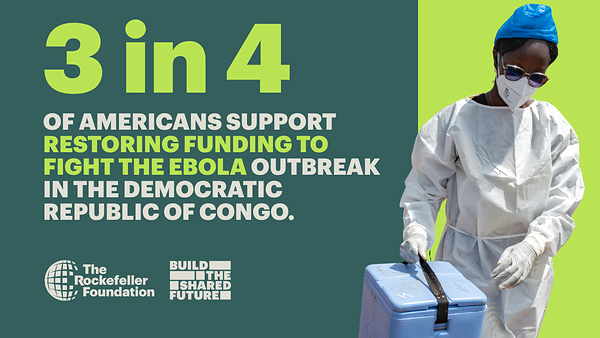
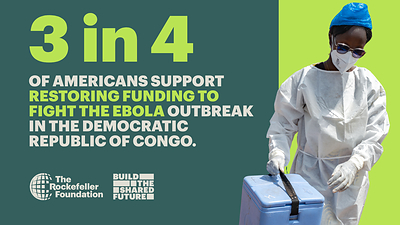
- Spotlight: The 2026 Ebola Outbreak. The survey was fielded against the backdrop of an active Ebola outbreak in the Democratic Republic of the Congo — a real-time test of how a current threat shapes views on aid. A majority of Americans (54%) say they are very or somewhat concerned about its potential spread to the United States. That concern translates into policy preference: 72% say the outbreak has led them to support restoring some or all U.S. global health aid worldwide — a result that holds across party lines and links the immediate crisis to broader aid policy. When shown expert estimates that foreign aid cuts could lead to more than 9 million deaths by 2030, 70% said they would support restoring aid funding.
“This data is a direct rebuttal to anyone who claims Americans have lost their appetite for the world. Americans never stopped being generous; Washington just stopped delivering on it,” said Dr. John A. Gans, former Chief Speechwriter at the Pentagon, author of White House Warriors, and current Senior Vice President and project lead at The Rockefeller Foundation. “250 years after America’s revolution and 1 year after USAID’s razing, a majority of Americans don’t just want to ensure federal funding to feed the hungry, cure the sick, and respond to crisis around the world—they see good reason to increase it. The lesson for Washington is clear: don’t doubt the generosity of Americans; deliver on it.”
An American Perspective on Foreign Aid is the latest research to be commissioned by The Rockefeller Foundation’s Build the Shared Future Initiative, through which the 113-year-old philanthropic organization aims to inspire and inform global cooperation and international development work that matches the challenges of the 21st century, including efforts to align with governments around the world to identify country-led solutions to maximize every dollar of remaining aid and to stimulate new investments.
About The Rockefeller Foundation
Investing $30 billion over the last 113 years to promote the well-being of humanity, The Rockefeller Foundation is a pioneering philanthropy built on unlikely partnerships and innovative solutions that deliver measurable results for people in the United States and around the world. We leverage scientific breakthroughs, artificial intelligence, and new technologies to make big bets across energy, food, health, and finance with our partners and our affiliated public charity, RFCC. For more information, follow us on LinkedIn @the-rockefeller-foundation, X @RockefellerFdn, Instagram @rockefellerfdn, and YouTube @RockefellerFdn, and sign up for our newsletter at www.rockefellerfoundation.org/subscribe.
 View original content:https://www.prnewswire.com/apac/news-releases/new-echelon-insights-survey-commissioned-by-rockefeller-foundation-most-americans-back-foreign-aid-a-year-after-usaids-end-302813680.html
SOURCE The Rockefeller Foundation


