
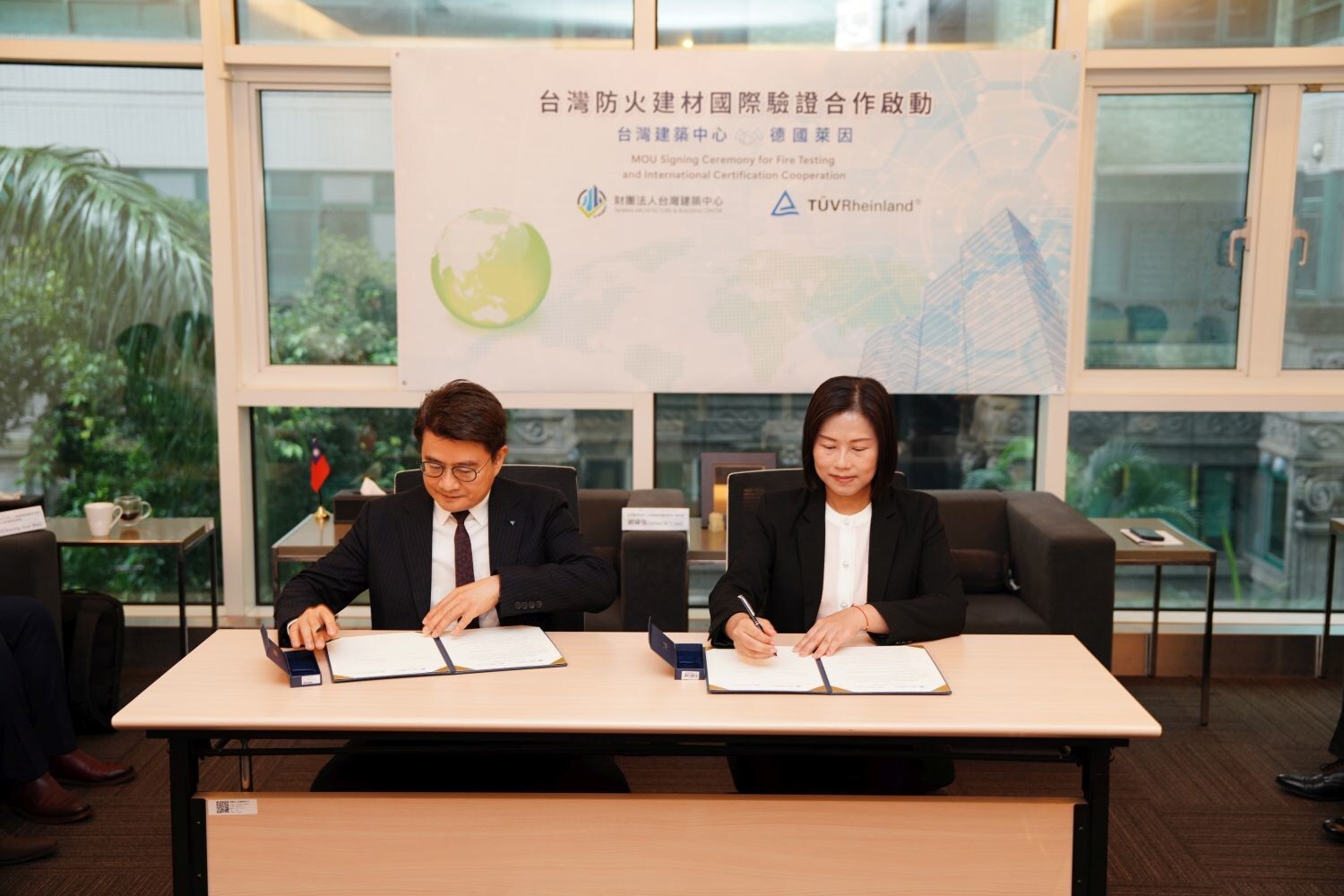
TAIPEI, June 12, 2026 /PRNewswire/ — The Taiwan building materials industry is expanding into Singapore, Europe, and other markets. To help manufacturers overcome technical barriers to international market access, the Taiwan Architecture & Building Center (TABC) and TÜV Rheinland signed a Memorandum of Understanding (MoU) on June 5 to establish a one-stop testing and certification collaboration framework for building materials. Through this collaboration, Taiwan manufacturers will be supported in meeting key regulatory and certification requirements, including fire safety requirements set by the Singapore Civil Defence Force (SCDF) and CE marking requirements under the EU Construction Products Regulation (CPR) for the European market. This initiative is designed to accelerate market access for MIT (Made in Taiwan) building materials and strengthen competitiveness across ASEAN and global markets.



The TABC has long promoted certification services for green buildings, smart buildings, fire safety, and seismic resistance. As an independent third-party organization, it possesses extensive expertise in building-safety evaluation and testing. Its materials laboratory has conducted designated fire-resistance performance testing projects commissioned by the National Land Management Agency in Taiwan and the Bureau of Standards, Metrology and Inspection (BSMI) for more than 20 years. TÜV Rheinland, meanwhile, brings more than 150 years of global testing, inspection, and certification experience, with expertise in CE marking, EU Construction Products Regulation (CPR), and fire-safety assurance. This collaboration combines international certification expertise with Taiwan’s testing capabilities to support fire safety compliance for global markets.
Singapore and Europe are key construction markets with strict fire safety requirements. International certification is required for access to Singapore government procurement, major developer, and EPC engineering supply chains. Entering the European market also requires CE marking under the EU Construction Products Regulation (CPR). This collaboration focuses on the fire-safety and fire-resistance performance of construction materials, supporting manufacturers from testing through certification and overseas market applications.
Previously, Taiwanese manufacturers seeking international certification often needed to ship fire-resistant building materials — sometimes weighing several hundred kilograms or even multiple tons — to overseas laboratories for testing. The process involved significant logistics costs, cross-border coordination challenges, product modification delays, and tender schedule pressures. Under this framework, testing can be conducted in Taiwan, reducing transportation and cross-border costs while enabling faster local coordination. This helps streamline procedures and reduce risks from overseas laboratory delays or testing failures.
For large-scale products such as fire-rated doors, fire-partition systems, and related building materials, the savings on a single project could potentially total hundreds of thousands of New Taiwan dollars in overseas shipping and expenses for repeated travel or testing. Certification lead times may also be shortened by one to three months, providing advantages in international engineering tenders.
Representatives from Taiwan’s building materials and construction sectors attended the signing ceremony to witness the launch of the collaboration. Both organizations will support earlier integration of international standards into product development, increasing adoption opportunities among architects, developers, and EPC engineering markets. The scope of cooperation will cover fire-protection materials, fire-rated doors and windows, partition systems, and related building materials, including combustibility, fire resistance, and flame-spread testing, particularly for high-tech facilities and public infrastructure projects.
At the ceremony James Liu, General Manager of Industrial Services & Cybersecurity at TÜV Rheinland Taiwan, stated: “Through this strategic partnership, we are bringing forward-looking international standards expertise to Taiwan. Together with the TABC, we aim to make Made in Taiwan synonymous with safety and reliability in global supply chains and major international engineering projects.”
Tsui Miao-Shen, Chairman of TABC, said: “The TABC has long been committed to building safety, construction materials testing, and technical industry services. Our collaboration with TÜV Rheinland will further connect Taiwan’s domestic testing capabilities with international certification systems, providing Taiwanese manufacturers with more comprehensive technical support in responding to overseas market requirements.”
By integrating Taiwan’s local testing capabilities with TÜV Rheinland’s global certification resources, this collaboration is expected to further strengthen the international competitiveness of Taiwan’s building materials industry and accelerate the global expansion of MIT building products.

