

Report outlines 2030 emissions targets, biodiversity conservation efforts, and social impact initiatives
SHANGHAI, June 2, 2026 /PRNewswire/ — On May 26, 2026, CHANDO Group hosted the launch of its 2025 Sustainability Report alongside a media salon at Oriental Beauty Valley • CHANDO Future Beauty City. Nearly 40 media organizations and industry experts gathered for the occasion, marking the Group’s 15th consecutive year of publishing its sustainability report.


At the event, Dr. Chen Juanling, General Manager of Public Affairs at CHANDO Group, shared the Group’s 2025 sustainability initiatives under the theme “Green Beauty, A Beautiful World.” She outlined the Group’s long-term sustainability efforts around three key priorities: environmental protection, social impact, and digital governance and compliance. In biodiversity conservation, the “Planting Grass in the Himalayas” initiative has restored greenery across 6.66 million square meters of land, helping raise local agricultural income, and the program entered a new phase last year as a five-year biodiversity conservation initiative. She also highlighted a notable milestone: the artificial cultivation of Gentiana veitchiorum in the Group’s public botanical garden in Lulang Town, Nyingchi Prefecture, Tibet Autonomous Region. The project has resulted in the first new cosmetic ingredient sourced from Tibet, demonstrating how scientific research and cultivation techniques can help protect rare plant species while supporting ingredient development. On the social front, the Group has continued its Spring Bud education program, contributed to the Shanghai Science and Technology Talent Return Initiative to help female researchers resume their careers, and provided rapid relief following the earthquake in Shigatse. “In the end, corporate sustainability is not only about growth figures, but also about the kind of growth a company creates,” she said. “CHANDO has been operating for 25 years and working in the Himalayas for 17 years. We move forward steadily and with conviction.”
Professor Yang Yongping, a researcher at the Xishuangbanna Tropical Botanical Garden under the Chinese Academy of Sciences, shared insights on biodiversity conservation, highlighting the Himalayas’ unique significance as one of the world’s 36 biodiversity hotspots. He discussed the region’s ecological value and challenges, noting that the southern slope of the Himalayas contains vertical vegetation zones comparable to compressing the ecological range from Hainan Island to Changbai Mountain into a single vertical wall, home to more than 10,000 vascular plants, one-third of which are endemic. However, climate change is driving glacial retreat and forcing species migration to higher elevations, making conservation increasingly urgent. He also acknowledged CHANDO Group’s long-term commitment in the Himalayas, spanning initiatives from “Planting Grass in the Himalayas” to the forthcoming publication Mysteries of the Himalayas: A Field Guide to Common Plants of Serjila Mountain, which together illustrate how scientific research and community participation can reinforce one another in conservation efforts.
Dr. Ren Hui, head of raw materials at CHANDO Group’s R&D Center, highlighted the Group’s work in ingredient research and development. From Antarctic yeast HiMurchaSin to the successful regulatory filings of Gentiana veitchiorum and Saussurea laniceps cell clusters, these achievements reflect the Group’s long-term investment in proprietary ingredient technologies. “True competitiveness is built on mastery of core ingredient technologies,” said Ren. “This capability helps turn sustainable beauty from an aspiration into a driver of product innovation.”
Report Details Progress Across Environmental, Social and Governance Priorities
The 2025 Sustainability Report outlines CHANDO Group’s approach, priorities, and performance across environmental, social, and governance areas. It also announces the Group’s 2030 emissions reduction target, aligned with the Science Based Targets initiative (SBTi), and expands its disclosure boundary to include six key Scope 3 categories. On the social side, the Spring Bud program has cumulatively benefited 860 female students in Tibet, while the Himalaya biodiversity initiative has been expanded into a five-year program. In governance, the Group prevailed in an e-commerce trademark infringement case involving unauthorized relabeling practices, establishing a legal precedent that supports stronger market oversight and compliance standards. These efforts reflect the Group’s transition from meeting sustainability commitments to managing performance through science-based targets and greater transparency, providing a measurable reference point for sustainability efforts across China’s beauty industry.

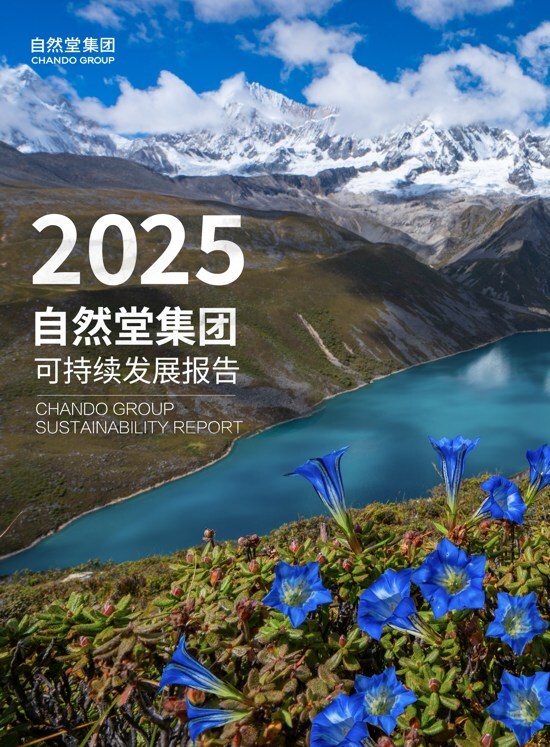
2025 CHANDO Group Sustainability Report
Zheng Chunying, Chairman and President of CHANDO Group, said that three trends continue to reshape the market: sustained industry growth, domestic brands entering the mainstream, and increasing consolidation. He noted that success now depends on remaining adaptable in a changing market, embracing change through continuous learning, sound judgment, and the ability to respond with agility, and turning market opportunities into long-term success. He added that in 2025, the Group achieved strong growth, with revenue exceeding expectations and both e-commerce and retail channels delivering strong performance.
Climate Action and Biodiversity Protection
Climate action and biodiversity protection are central to CHANDO Group’s 2030 sustainability strategy. In 2025, the Group completed a full greenhouse gas inventory covering Scope 1, Scope 2, and six key Scope 3 categories, and established a decarbonization roadmap. Using 2023 as its base year, the Group has committed to reducing absolute Scope 1 and Scope 2 emissions by 42% by 2030, in alignment with SBTi standards.
CHANDO Future Beauty City Opens as a Hub for Sustainable Manufacturing and Industrial Tourism
Located in Shanghai’s Oriental Beauty Valley, CHANDO Future Beauty City officially opened on October 28, 2025. The facility combines solar power generation, intelligent logistics, and industrial tourism, and has been recognized as one of Shanghai’s Top 10 Landmark Cultural and Tourism Projects of 2025, as well as a 2024 Advanced Smart Factory. More than a visitor destination, it showcases CHANDO Group’s manufacturing, sustainability, and innovation initiatives. The project brings together industrial operations and public engagement through a model that integrates culture, tourism, commerce, sports, and exhibitions.
CHANDO Group views the facility as an opportunity to give visitors a closer look at modern manufacturing and the technologies that support its operations. By opening parts of the production environment to the public, the project helps connect consumers with the brand’s products, processes, and sustainability efforts. Rather than functioning solely as a corporate exhibition space or tourist attraction, the facility is designed to make the company’s operations more accessible and transparent while creating a more engaging visitor experience.
The Future Beauty City is integrated with CHANDO Group’s manufacturing operations and features a 3.1 MW rooftop solar installation. Designed primarily for on-site consumption, with surplus electricity supplied to the grid, the system is expected to generate approximately 3.8 million kWh of renewable electricity annually. It is projected to meet 24.62% of the site’s electricity demand while achieving a self-consumption rate of 95.26%. The installation is also expected to reduce carbon emissions by approximately 1,787 tons per year—the equivalent of planting 89,350 trees. By replacing conventional electricity with solar power, the project helps lower energy consumption costs, improve energy efficiency, and support the Group’s emissions-reduction goals.
CHANDO Future Beauty City has also introduced a lights-out logistics system designed to automate warehousing and transportation operations, reducing energy consumption through intelligent scheduling and automation. Water recovery initiatives, including concentrated wastewater and steam condensate recycling projects, further improve resource efficiency. Meanwhile, digital twin technology and an intelligent supply chain platform help optimize the management of materials and energy while contributing to emissions reductions across the value chain. Together, these initiatives reflect the facility’s focus on sustainable manufacturing, operational efficiency, and greater transparency in how products are made.
Ten Years of Biodiversity Conservation in the Himalayas, Benefiting Ecosystems and Local Communities
From 2016 to 2025, CHANDO Group has supported ecological conservation efforts in the Himalayas, the region that inspired the brand and remains central to its sustainability initiatives. Since 2016, the Group has partnered with the China Environmental Protection Foundation to establish the “CHANDO Himalaya Environmental Protection Public Welfare Fund,” through which cumulative donations have reached RMB 29.2 million to date.
The “Planting Grass in the Himalayas” program has been carried out for eight consecutive seasons, with a total of 6.66 million square meters of wheatgrass planted in Shigatse, Tibet. The grass helps stabilize shifting sand, improve soil quality, and provide high-quality forage for local communities, helping ease winter feed shortages. In March 2025, the program’s eighth annual profit-sharing event was held in Gangxi Village, Xiqing Township, Lazi County, Shigatse. In 2024, the project generated net income of RMB 950,000, part of which was distributed to villagers as dividends, benefiting 155 households and 706 residents, while the remainder was invested in agricultural machinery for the village cooperative. In addition to supporting ecological restoration, the initiative has created local employment opportunities and generated additional income for participating communities.
Building on earlier phases of the program, the Group expanded the “Planting Grass in the Himalayas” initiative in 2025 into the “2025–2030 CHANDO Sustainable Himalaya Biodiversity Conservation Project.” In this new phase, the Group’s activities advance the three objectives of the Convention on Biological Diversity—biodiversity conservation, sustainable use of biological resources, and fair and equitable benefit-sharing. Through initiatives including educational exhibits, field expeditions, and academic seminars, the Group engages the public and research community on issues related to biodiversity conservation and sustainable development in the Himalayan region.
As part of its efforts to support biodiversity conservation through scientific research, the Group, in collaboration with Xizang Agricultural and Husbandry University, obtained approval from the National Medical Products Administration in 2025 for a new cosmetic raw material derived from Gentiana veitchiorum extract, marking the first such filing in the history of the Tibet Autonomous Region. The ingredient is sourced from Gentiana veitchiorum plants sustainably grown in CHANDO’s public botanical garden in the Himalayas. By establishing its own cultivation base, the project helps protect a rare species while also creating local employment opportunities and generating sustained economic value for surrounding communities.
Building on its work with Gentiana veitchiorum, CHANDO Group has expanded its research into rare botanical ingredients. In March 2026, the Group’s application for a new cosmetic raw material based on Saussurea laniceps cell clusters was approved by China’s National Medical Products Administration. Saussurea laniceps is a rare species found exclusively in the high-altitude regions of the Himalayas and is classified as a nationally protected endangered wild plant (Category II). The Group’s botanical ingredients R&D team was authorized to collect a limited number of seeds, which were then germinated in a laboratory setting using plant tissue culture techniques to develop plant tissue cultures. The process enables large-scale cultivation and commercial application of callus derived from rare alpine plants. This breakthrough demonstrates CHANDO Group’s growing capabilities in plant cell culture technology and illustrates how rare botanical resources can be developed more sustainably.
Driving Sustainable Beauty Through Clean Technology and Ingredient Innovation
CHANDO Group believes that sustainable beauty is driven not by using more natural ingredients, but by science-backed innovation that unlocks the value of nature while ensuring efficacy, safety, and environmental responsibility. Guided by its philosophy of drawing inspiration from nature and advancing it through science, the Group embeds sustainable technologies throughout its innovation ecosystem, spanning ingredient discovery, R&D, efficacy evaluation, and safety science. In August 2025, CHANDO Group inaugurated its Shanghai Microbiology Laboratory, which features fifth-generation intelligent bio-fermentation technology, marking a significant step forward in strengthening in-house capabilities for the development and production of key bioactive ingredients. Dedicated to the large-scale cultivation of yeast and lactic acid bacteria, the facility has increased production capacity fivefold and is designed to deliver annual output exceeding 1,000 tons. Through closed-loop treatment and resource recycling systems, the laboratory achieves full raw material utilization and zero-waste production while maintaining near-zero emissions.
A notable example is HiMurchaSin, a proprietary ingredient developed using CHANDO Group’s fifth-generation intelligent fermentation technology. Compared with conventional production methods, the process increases active ingredient extraction efficiency by 300% and reduces energy consumption by 25%, while maintaining full material conversion and a biodegradable, zero-emission production process.
In ingredient sourcing, CHANDO Group prioritizes renewable and sustainable resources. Through its proprietary live flower aroma capture and molecular replication technology, the Group can preserve and reproduce fragrance molecules from high-altitude botanical species without disrupting their natural habitats. The technology has already been applied to more than ten fragrance profiles across skincare, body care, and color cosmetics products. Leveraging plant tissue culture technology, CHANDO also supports the cultivation and use of rare plant resources while reducing reliance on wild populations. Its Pink Diamond Firming Delicate Rose Cream features ingredients derived from a Pan-Himalayan rose germplasm collection sourced at an altitude of 3,300 meters. Enhanced through space microgravity breeding and plant cell culture technologies, these ingredients deliver enriched bioactive profiles and improved efficacy.
Promoting Circularity Through Sustainable Packaging
Sustainable packaging and circularity initiatives were key highlights of CHANDO Group’s sustainability report. Through streamlined packaging design, scalable process optimization, and expanded refill programs, the Group continues to reduce resource consumption and packaging waste at the source. In 2025, 90 product SKUs were upgraded under the Group’s plastic reduction program. Production of 370,000 refill units of Little Purple Bottle Essence reduced virgin plastic consumption by approximately 0.54 tons, while 326,000 refill pouches for shampoo and body wash products reduced virgin plastic use by around 14 tons.
The bottle used for CHANDO Snowy Region Lotion incorporates a pioneering one-step color gradient blow-molding process developed over seven years, reducing carbon emissions by more than 90% compared with conventional spray-coating methods while eliminating paint usage entirely. FSC-certified packaging has also been introduced across the Group’s pediatric functional skincare line, supporting responsible forestry practices and lower environmental impact.
As part of its commitment to advancing a circular economy, CHANDO Group continues to expand its empty bottle recycling program, which has engaged more than 10,000 consumers since its launch. Consumers can return used packaging at designated retail locations in exchange for membership rewards and complimentary skincare services. Through the collection, sorting, and responsible processing of returned packaging, the Group has established a closed-loop recycling system that helps reduce waste while encouraging more sustainable consumption habits. In recognition of these efforts, CHANDO was selected as a Shanghai municipal “Waste-Free City Cell” exemplary case in 2025, reflecting the environmental impact of these initiatives.
Putting People First Through Meaningful Social Impact
CHANDO Group’s sustainability approach is built on a holistic consideration of environmental, social, and governance factors, aiming to support sustainable business growth while delivering lasting value to society.
The Group continues to strengthen its commitment to philanthropy and community engagement, using charitable initiatives to expand access to educational opportunity, cultural preservation, and regional development. In 2025, the Spring Bud Program donated RMB 2 million to the Tibet Women’s Federation to benefit 350 outstanding female students from institutions including Tibet University, Tibet University of Tibetan Medicine, and Xizang Agricultural and Husbandry University. As of 2025, the program had contributed RMB 5.6 million over three years, benefiting 860 female high school and university students across the Tibet Autonomous Region. Beyond financial support, the Group complements the program with career development workshops, science and technology training, and social practice opportunities in Shanghai, helping participants build skills and prepare for future educational and career opportunities.
In addition, CHANDO Group responds to urgent community needs through a range of charitable initiatives. Following the 6.8-magnitude earthquake that struck Dingri County in Shigatse in January 2025, the Group partnered with the China Environmental Protection Foundation to deliver emergency relief supplies to affected communities. It also launched its “Care Alliance” winter clothing donation campaign, collecting 638 kilograms of warm clothing for children in Seda and Batang counties in Sichuan Province. In September 2025, CHANDO donated RMB 500,000 to the Shanghai Science and Technology Talent Return Initiative, helping female researchers return to scientific careers after childbirth.
Strengthening Corporate Governance and Business Integrity
At the governance level, CHANDO has established a three-tier ESG governance framework spanning board oversight, management coordination, and operational execution, supporting the implementation of its sustainability strategy across the organization.
The Group also continues to strengthen intellectual property protection and industry compliance. In December 2025, it secured a significant legal victory in a case involving unauthorized relabeling practices on e-commerce platforms, obtaining a favorable judgment from the Yuhang District People’s Court in Hangzhou. The ruling established an important precedent for distribution compliance within China’s beauty industry, and CHANDO was subsequently awarded the Shanghai Intellectual Property Innovation Award (Protection).
By the end of 2025, CHANDO Group had filed 559 patent applications, including 290 invention patents, and had been granted 238 patents, of which 111 were invention patents.
In digital transformation and data security, CHANDO Group continues to advance its digital transformation efforts. By 2025, AI technologies had been progressively integrated into marketing content creation, livestream operations, and intelligent customer service. At the same time, the Group completed Level 3 cybersecurity compliance assessments for five core systems, further strengthening consumer data protection and information security.
ESG in Action: CHANDO’s Sustainability Journey
“Fulfilling social responsibility is both a founding aspiration and a lasting commitment,” said Zheng Chunying, Chairman and President of CHANDO Group. “For CHANDO, corporate social responsibility is not an optional philanthropic gesture, but a long-term business priority that supports the brand’s continued development.”
CHANDO Group’s environmental restoration projects, educational initiatives, circular-economy programs, and efforts to protect intellectual property all reflect a common principle: sustainability is not a cost, but a long-term investment in value creation.
As CHANDO Group celebrates its 25th anniversary, it enters a new phase of development. Guided by its “Together, More Beautiful” philosophy, the Group will continue to work with consumers, partners, and communities to help shape the future of sustainable beauty in China.

